

When I heard that plans are afoot (love that phrase) to remove more large, beautiful trees in Salem's downtown historic district, my interest was aroused.
After all, I followed the 2013 U.S. Bank tree removal debacle extremely closely.
Eventually I wrote a tell-all report, "Outrage: Salem's U.S. Bank tree killings," about how the bank president and City of Salem Public Works director cut down five large, beautiful trees for no good reason, then misled the public about why they did it.
I also was instrumental in saving some large, beautiful trees on downtown's High Street. In this case a property owner trusted the opinion of Salem's Urban Forester, Jan Staszewski, regarding the supposedly diseased condition of the trees.
At my request, a certified arborist (Staszewski isn't one) found that the trees actually were healthy and didn't need to be cut down. The building owner was pleased to hear that, as he wanted to keep the trees but had trusted the City of Salem's Urban Forester.
Every time I drive down High Street I feel thankful that the trees still grace the area south of the Elsinore Theatre.
So this explains why I jumped into Blogger Investigative Action after hearing talk about trees adjacent to the McGilchrist building on State and Liberty being removed. What I learned today isn't nearly as outrageous as what happened in the U.S. Bank tree removal fiasco, but still has some disturbing aspects.
First though, the good news.
After doing some Googling and finding an urban renewal document that describes the $60,000 worth of sidewalk improvements to the half blocks adjacent to the McGilchrist building, which is being remodeled, I phoned the owner's representative who had submitted a letter describing the planned work.
David Holton confirmed that the words "replacement of missing street trees" meant that the intention is to preserve all of the current trees (two on State Street, one on Liberty Street) and add a replacement tree, or trees, since one had been cut down and a new tree wasn't replanted.
He had a "but," though. If the Urban Forester, Jan Staszewski, determined that any of the trees were diseased and should be removed, they would be.
That led me to email Staszewski and ask for copies of any documents related to removal of trees adjacent to the McGilchrist building. Simple request. But these days staff at City Hall often are unnecessarily secretive.
Staszewski replied that he'd been directed to tell me I had to make a public records request, adding, I'm pretty sure (his language was somewhat confusing) that a request to remove the trees wasn't related to any building renovation.
This was irritating, because filing a public records request takes time. I had to fill out a form, scan it, then email it to the City Recorder's Office with a plea that I get the documents ASAP. Which probably won't be as soon as I want and need them.
Typically staff get an estimate of how much it will cost to fulfil a public records request. Then the requestor has to pay that amount before the records are produced. I've had this take a month, though sometimes City staff will email a document quickly at no charge.
I also asked City Councilor Chuck Bennett if he could get the documents about any planned tree removals. Bennett said he would make a request and forward them to me. So far, I haven't gotten any documents. This is bothersome because street tree removals are the public's business. There shouldn't be anything hidden about the process.
Staszewski could have simply explained to me what is going on, and emailed me any relevant documents.
This is what I did when I handled public information requests for the Oregon health planning agency. We never charged for documents, and we never made people go through a bureaucratic process to get information about what the agency was doing.
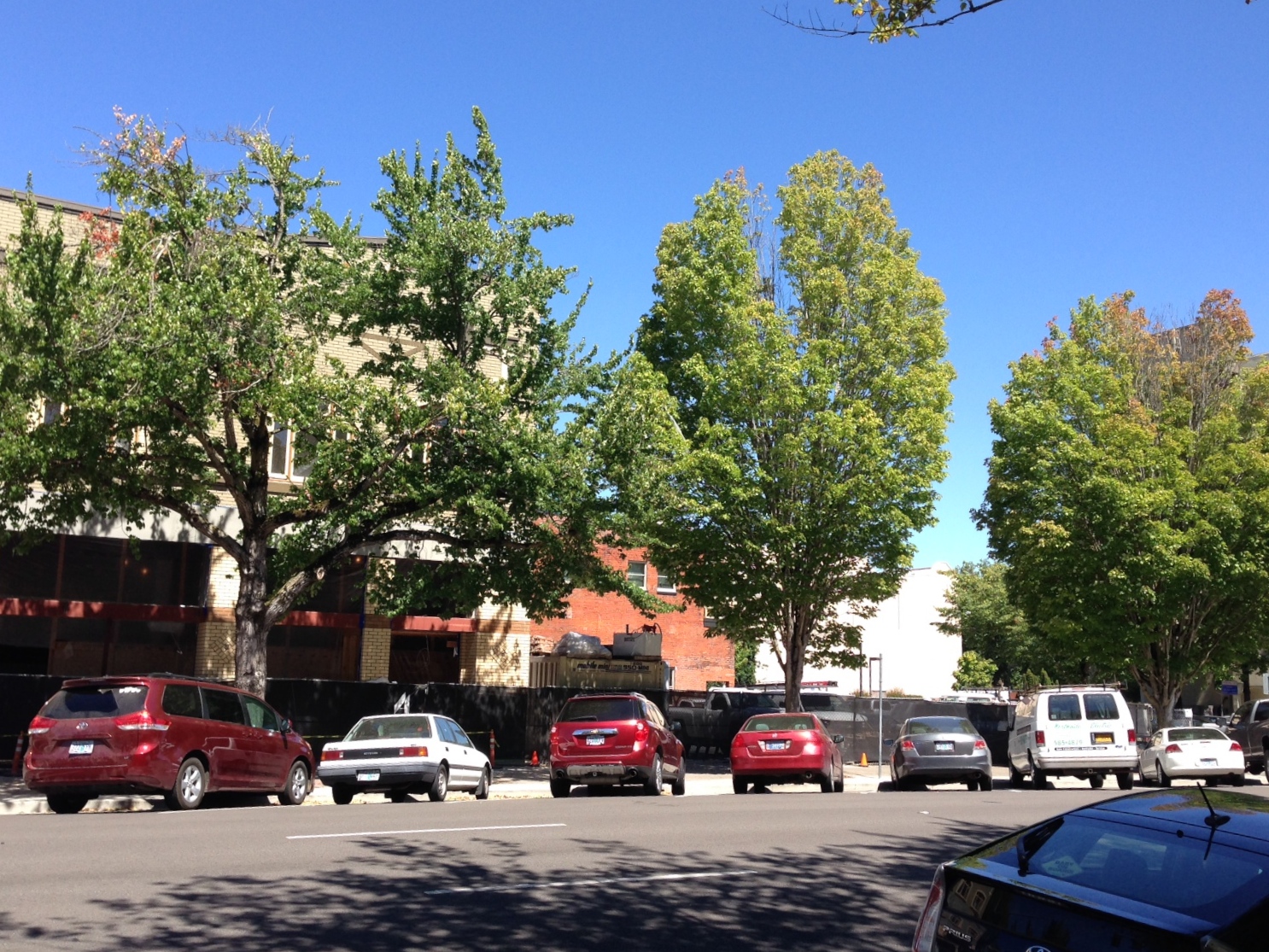
I drove downtown to take a look at the trees today. I took some photos of the trees on State Street. They're large and beautiful. But I couldn't assess their health, not being a tree expert. However, someone who is agreed to give me an assessment. Which in summary was:
I believe the tree [on the left in the photo above] to be in a state of decline. It is not knowable at this time if any measures taken could hold off or reverse the decline.
So it may be advisable to remove the tree, or it may not. More study is needed. And not just by the City's Urban Forester, Jan Staszewski. This was one of my points in a blog post about the High Street trees that had been incorrectly diagnosed as diseased.
I don't blame the property owners for wanting to have the trees removed, since the City of Salem erroneously told them that the trees were diseased.
I do blame Urban Forester Jan Staszewski and Public Works Director Peter Fernandez for not getting a second or third opinion on the condition of the Upright European Hornbeams.
Cutting down beautiful mature downtown street trees that are 40 to 50 years old, 35 to 40 feet high, and 12 to 19 inches in diameter shouldn't be done lightly. Very good reasons for doing so have to be supported by solid arborist evidence.
Which raises a question for me: if the City of Salem Public Works Department was wrong when it decided these trees should be cut down rather than pruned, what else is the Department wrong about?
Meaning, if solid facts and expert advice aren't guiding Public Works decision-making, then what else is?
As should be obvious, I've lost trust in the City of Salem's ability to properly manage and take care of its many street trees. I've heard too many stories about bad tree decisions (one told by myself) to uncritically accept a tree removal recommendation by city staff.
Large beautiful street trees, especially in the downtown area, are a valuable asset. In this case it's great that the owner of the McGilchrist building recognizes this. However, they are leaving it up to the Urban Forester to decide whether all of the existing trees can remain.
As noted above, I strongly feel that second or third opinions by certified arborists should be required before a large street tree is removed by the City of Salem due to supposed poor health.
My wife and I live on ten rural acres. We frequently get advice about what to do with a tree that is having problems. We've found that tree experts will disagree about whether a tree can be saved or treated. Since we're talking about living public assets that may be worth tens of thousands of dollars, it makes sense to get a second or third opinion before cutting down a tree.
Further, I was told by the tree expert who inspected the trees on the State Street side of the McGilchrist building that prior sidewalk repairs by the City seem to be what caused the tree to go into decline. This points to a problem not only with tree maintenance, but general maintenance by the City of Salem.
Not nearly enough is being done.
The City's parking garages have a lot of deferred maintenance. So does the Civic Center, many millions of dollars worth. My wife and I observe recently planted street trees dying for lack of care. Other trees have gotten a pruning hatchet job, either by a property owner who didn't care about proper pruning, or incompetent City staff.
It makes no sense for City officials to let existing assets deteriorate while trying to foist an unneeded $425 million third bridge or overpriced $85 million police facility and Civic Center project on taxpayers. Let's keep what we have in good repair before building any new stuff.
It bothers me to see large beautiful street trees treated like disposable junk, rather than the precious commodity they really are. Hopefully much careful thought and research will go into deciding whether any of the McGilchrist building trees need to be cut down, or whether all can be saved through expert arborist care.
It also bothers me when information about the public's business, such as the planned removal of street trees is so difficult to get from the City of Salem. City staff should be open, transparent, and helpful when contacted by citizens, not closed, secretive, and distant.
Discover more from Hinessight
Subscribe to get the latest posts sent to your email.