

Salem sucks when it comes to the sort of bicycle/pedestrian infrastructure Gil Penalosa and other proponents of so-called "alternative" transportation say is sorely needed in every city. Check out 8-80 Cities.
(That word, alternative, assumes that cars are the normal way of getting around. However, given the course of history it is obvious that human legs have that honor. As Penalosa likes to say, walking begins and ends every trip by car, plane, train, bus, or any other form of powered transportation.)
My wife and I have mountain bikes. I also am addicted to an outdoor elliptical bike, the Streetstrider, which I habitually ride for 45 minutes or so, three times a week, on the paved multi-use trails at Minto Brown Island Park.
Other than a few bike rides at Riverfront and Wallace Marine parks, I never, ever ride in Salem. I also can't imagine inviting my seven year old granddaughter to ride a bike with me in Salem, aside from the dedicated park trails.
This is a big drawback for Salem.
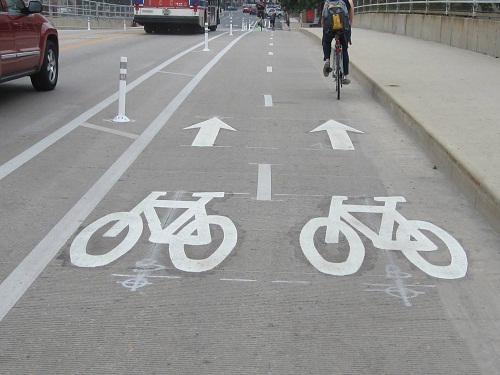
More and more, individuals, families, and businesses are paying attention to the quality of life available in a town when they think of relocating. Being able to get around a city safely, quickly, and enjoyably on dedicated bike trails/lanes is an important aspect of quality of life for both young and old.
So I thought to myself, Damn, Salem is getting upstaged, when I saw a story in today's paper: "Cycling advocates hope to make Silverton bike-friendly."
Download Cycling advocates hope to make Silverton bike-friendly
Silverton could gain more bike trails, bike lanes, bike shops and cyclists in the coming years, and it would be due to the efforts of a citizen's committee spending long hours to make it happen.
Charles Baldwin and a group of avid cyclists spent 2014 compiling the Silverton Bicycle Report for the City Council, and during the Monday, Jan. 5, meeting presented 22 recommendations on how to make Silverton a destination for cycling activity. The goal: cash in on an estimated $400 million in annual revenue that comes from cycling tourism, according to a 2013 report by Travel Oregon.
As far as I know, there's nothing like that happening in Salem.
Our current Mayor, City Manager, and City Council generally are uninterested in making cycling a Salem priority. They've been pushing expensive autocentric projects, such as an unneeded billion dollar Third Bridge, rather than much lower-cost bicycle and pedestrian infrastructure.
Yes, in 2016 the walking/biking bridge between Riverfront and Minto Island parks should open. I'm looking forward to it. This will be an attraction for residents and visitors alike. But once bicyclists reach downtown, they'll face the scary riding prospects we have now.
Basically, a painted bike symbol in the middle of a car lane. This is so NOT what Gil Penalosa advocated when he gave an inspiring talk in Salem last year. I blogged about it in "Gil Penalosa shows Salem how to become a more vibrant city."
Here's how I ended the post.
Salem Breakfast on Bikes asked a good question in another post: "After Gil, what next?"
Great question. The City Council and other leaders in our semi-fair town need to get off their carcentric butts and start making Salem much more pedestrian and bicycle friendly.
Otherwise, as Penalosa said, people who want quality of life and can choose where they live will pass Salem by, as so many professionals and executives already do (working in Salem and living in Portland is a common lifestyle choice).
Since, and it has been almost a year since Penalosa came to town, nothing much has changed. I'm not aware of the bicycle community in Salem doing anything to push City leaders to make alternative transportation the norm, rather than an afterthought.
Cyclists in Silverton are.
Good for them. Maybe one day Salem will catch up to our neighbors to the north, east, and south — Portland, Corvallis, Silverton — when it comes to encouraging cycling.
Until then, I'll dream of the day we can do what Silverton is attempting.
From accommodations to local restaurants — the Travel Oregon report showed 58 percent of cyclists visited a local microbrewery during their trip — businesses stand to gain from improved cycling infrastructure.
So do Silverton residents, Baldwin said. Sitting in Gear Up Espresso, where he and the citizen's committee meet every month, he described in great detail trail projects that could connect the community and showcase the beauty in and outside the city. From an expansion of Steelhammer Road to the long-term "rail to trail" project on the city's railway, Baldwin said the opportunities to build a healthy cycling industry are here.
…The challenge for cyclists, Baldwin said, is not finding people who agree trails are a good idea, but rather finding the funding. Trail projects cost money and require both assistance and approval from city, county and state officials.
"We need to have some sort of critical mass in order for the city to say yes," Baldwin said, noting that the bike improvements he has helped create in Silverton had garnered wide support from businesses and the cycling community.
Discover more from Hinessight
Subscribe to get the latest posts sent to your email.
Yes, and no.
Probably the biggest thing that you and others can do is to be more willing to consider priced curbside parking. I don’t know if it is the number one barrier to improved bike lanes, but once we better manage parking, we will have more room to reallocate traffic lanes and other public space in the roadways. Free parking is a huge barrier to improved facilities, really.
As for recommendations…
For a few years under Mayor Taylor the Vision 2020 bike/ped group met. The City didn’t do much with it and ultimately disbanded it.
Bike and Walk Salem, now adopted into the Transportation System Plan, also has yielded considerably more than 22 recommendations.
Additionally, the Salem Area Trail Alliance is working off-road on the Wallace Bike Park and some other trail projects in Salem.
For better or worse, this is where the interests of most Salemites seem to be – for off-road recreation facilities rather than in-road transportation facilities.
The piece on Silverton is very rah-rah, and they have installed a bike corral, which Salem has not, but the challenge is not to articulate a list of recommendations, which has been done here in Salem over and over, but to fund and construct the items on the list.
The enthusiasm is always high in the beginning.
Let’s see how the momentum carries forward before we look to them as a template or scolding example for Salem to follow. Maybe they will be greatly successful, or maybe they will run into many of the same problems.
Leadership by electeds and city management staff will have a meaningful impact.
It’s too early to draw big conclusions from early stage hopes.
*now adopted into the Transportation System Plan…
If readers are interested in advocacy opportunities, here’s a partial list:
1) At two meetings in February, City Council meets to set the new Council Goals, the high-level policy goals that will set Council and Staff action for the next two years. One of the goals that has not very passionately been followed is for better bike connectivity. It would be helpful for Councilors to hear a reminder (and also to hear that resources being spent on the Third Bridge would much better be spend on improving safety and comfort for people on foot and on bike).
2) South Commercial is awful for walking and biking, and there is a City Study to develop a list of improvements. The Commercial-Vista Corridor Plan just kicked off, and a surge of public comment in support of better walking and biking conditions will help push the study in bolder directions. It looks like it will be on the timid side right now.
http://www.cityofsalem.net/CommercialVistaPlan
3) Advocate for the Downtown Central Salem Mobility Study. This specifically is a place where the commitment to copious free parking interferes with putting in stronger sidewalks and bike lanes downtown. The City is beginning to plan for some changes on High and Church Streets, but only “phase I” of the recommendations. Let City Council know they should move more assertively on the recommendations.
http://www.cityofsalem.net/mobilitystudy
4) Bike and Walk Salem was adopted a few years ago now, and the City has been slow to move on it. Let your City Councilor know that implementing its recommendations is important.
A group of neighbors in Highland and Grant are working on building support for a family-friendly bikeway on Maple and Winter Streets into downtown, ultimately to connect to the Kroc Center so kids could actually bike there and not rely on the mom-chauffeur.
The City has scheduled work on the connection to the Union Street Railroad Bridge at Commercial street (but way out in 2018!), which can be a remarkably treacherous crossing, but there is no plan yet to make the whole length of Union Street a family-friendly bikeway. With the opening of the Minto Bridge in a year or two, it would be great for kids and families from close-in neighborhoods to be able safely and comfortably to bike and walk on their own to Riverfront Park.
From the south, there’s an opportunity to create a family-friendly bikeway along Church Street, which would connect Bush Park to downtown and Riverfront Park.
5) The West Salem Business District Action Plan is in progress and one of the things they are considering is a local street under Wallace Road that would connect to Second Street and to the Union Street Railroad Bridge. The biggest fail on the bridge project was not including a connection across Wallace Road. If you’ve been down it, the path just ends. It’s dumb. The proposal in the action plan seems to be the most serious attempt to make a connection, and while it is not perfect, it is worth supporting. The way the Edgewater district is separated from Wallace Park and the Union St Bridge needs to be fixed.
http://www.cityofsalem.net/westsalemplan
These are official, actual City processes that will yield, or have yielded, plans eligible for local, state, and federal funding. (Wish lists by gung-ho advocates are rarely eligible for state and federal funding it is important to note.)
Supporting these projects with a range of perspectives – so it’s not just the wacko fringe bikey people asking for them – showing that there’s broad support among the public who understand that making it easier for people to walk and bike and bus also makes it easier for those who still need to drive, this is what will make stuff happen in Salem.
Salem downtown is ridiculously dangerous for biking. And, one HAS to stay on the street with the cars and parked cars. The designated bike lanes tend to be on the busiest streets where you have to ride beside cars in a lane filled with broken glass, other debris and sewer grates. Some bike lanes in south Salem are so steep that no one uses them and brambles grow over them, so you have to go out in the car lanes anyway. I ride all over town a lot and I keep to residential side streets and the park paths. I rode last night to Pringle Hall for a city presentation on Minto-Brwon Park planning. I was the sole bicyclist there – good thing, as they have but one small bike rack – hidden out back. I was amazed at how many people complained about inconsiderate bicyclists on the Minto pathways, when I find that groups of people spreading out completely across the path and blocking bikes is an issue.
Michael, good point — about people spreading across the entire Minto Brown path. I frequently encounter this myself. I can understand why a couple would like to walk side by side. But often I’ll see a group of four or more also walking side by side, taking up the whole path.
Maybe the park needs some basic “rules of the road” signs. Such as, stay to the right whenever possible; bicyclists, let walkers know you are coming if there is any risk of a collision, etc.
Sometimes I say “on your left,” or whatever, but sometimes I don’t if the person/;people are way over on the right and there is no sign that they are weaving back and forth on the path. I’ve found that saying “on your left” occasionally will cause people to look forward and turn to the left, which isn’t good.