Salem Community Vision – I'm a member of the steering committee — has come up with some goals for the Salem City Council to consider.
We believe that if our local elected officials made these goals a priority, Salem's citizens would benefit economically, culturally, environmentally, quality-of-life'ly and healthily.
Who knows?
Birds might also sing more tunefully; flowers would bloom more colorfully; the sun would shine daily, even when it is raining. That's how great these goals are!
They've been shared with the Mayor, City Manager, city councilors, and other City officials, who are going to have a 2015-17 goal-setting work session on March 16. An abbreviated version was published in the Statesman Journal as a letter to the editor.
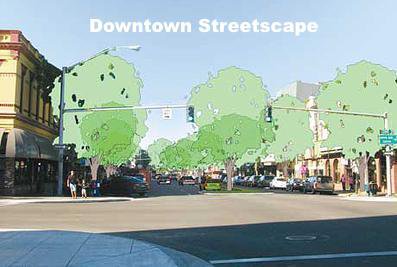
I've added some links in the titles of the goals for anyone who wants more info about them. The image below comes from Salem Community Vision's project page, which includes Downtown Streetscaping.
In advance of the City Council’s upcoming goal-setting work session, Salem Community Vision would like to suggest that these goals be top priorities for the City of Salem in the coming years.
(1) Fix and improve the existing Willamette bridges. It is vital that the two bridges we already have be seismically retrofitted as soon as possible, before the Big One earthquake hits. This, along with improvements to the bridgeheads that would improve traffic flow, can be done for much less money than a third bridge would cost.
(2) Streetscape downtown. Salem’s urban core needs to become much more pedestrian and bike-friendly. Plans already exist for streetscaping the Historic District by adding attractive plantings and other features, while lessening the negative impact of vehicular traffic on visitor enjoyment of the area.
(3) Revise the tree ordinance. Revisions to Salem’s tree ordinance have been drafted by a group of concerned citizens. These appear to be marked improvements over the current ordinance, which has allowed downtown trees to be removed unnecessarily — leading to justified protests and controversies.
(4) Create a Sustainability Commission. Salem’s reputation as a “sustainable community” lags behind that of other neighboring cities such as Portland, Corvallis, and Eugene. This harms our ability to attract people and businesses who are concerned with environmental and quality of life issues.
(5)
Re-prioritize transportation planning/funding. With fewer people driving, and more choosing mass transit, biking, and walking, Salem needs to rethink how and where it spends limited transportation dollars. For example, a neighborhood-based effort to create “bike boulevards” throughout Salem should be a priority.
(6) Encourage incubator business start-ups. Empty storefronts are a drag on Salem. They give both visitors and residents a negative impression of our community. The City needs to do more to support creative small business start-ups which are a key to revitalizing not only downtown, but other lagging areas of Salem.
I encourage you to
email City officials and tell them how you feel about these goals. Or suggest other ones.
Email address is: citycouncil@cityofsalem.net
Discover more from Hinessight
Subscribe to get the latest posts sent to your email.


I would revise 6 to read “Discourage Unused and Underused Space by Charging Owners for Degrading The City” — instead of putting the city even more into the “subsidy for business” business, we let the market figure out what’s best, by forcing building owners to pay a rising fee monthly for each month after a minimum (3?) that a developed lot or storefront within the downtown core remains vacant or underused.
The money would go into funds for downtown projects, so it would benefit the downtown businesses indirectly, and help ameliorate the burden they bear because other building owners let their properties be idle so long, exerting a drag on all downtown businesses.
In this way, instead of promoting graft and city government cronyism, we get a uniform, transparent policy that will strongly incent landlords to find and keep suitable tenants downtown, or sell to someone who will use the space themselves or wants to be a better landlord at rents the market is willing to pay. Right now, we’re suffering from landlords who aren’t paying high enough carrying charges on their buildings, so they’re fine with no rent coming in too long. Rather than raise taxes generally, we should simply penalize the landlords who impose costs on downtown with their refusals to bring the rents down enough to get a tenant into the space.
#2 and #5 will never happen as long as we have a major east / west highway artery (Hwy 22) dumping traffic directly dead center in our city.
Until that problem is corrected, there are not enough bong hits, Ty chi dances, or “If you’re happy and you know it clap your hands” songs to wish it into existence.
When traffic east / west can continue on Hwy 22 at 55mph AROUND the city center, then and only then will we have the quiet little hamlet that you dream about.
O.K back to what you were doing and no Bogarting….
Walker, I like your ideas. Penalizing property owners who choose to let a building sit idle (for tax reasons, or whatever) makes a lot of sense.
But seemingly this policy could co-exist with support for helping entrepreneurs start a new business once they’ve found a suitable and fairly-priced empty storefront to buy or lease.
I understand your concern about cronyism, as this is on evident display in Salem — with tax breaks going to wealthy, well-connected corporations like Mountain West. However, if support for new small businesses could be done fairly and fairly inexpensively, this seems like a good thing.
A while back, we saw a plan for Salem downtown traffic management from the U of O architecture people that decreased the number of lanes of travel and increased space for other means of transport. It was awesome. It must exist somewhere.
Bill, here’s a link to a discussion of the UO Sustainable Cities Initiative residency on downtown –
http://breakfastonbikes.blogspot.com/2011/07/tyranny-of-levels-of-service.html
In it is a link to the “Downtown Salem Circulation Study,” which seems like it is the study you reference.
Chunks of that project moved forward into the City’s own Central Salem Mobility Study, and asking the City to accelerate implementation of that would be a fine thing indeed.
I want to register my disagreement with Mr. Vanderpool. Sir, have you ever been to Vancouver, BC? The Economist ranks it the most livable city in North America. And guess what. It has no urban freeways or expressway loops. The cars and trucks just all have to slow down. And it works just fine. I have been there many times and there is almost no traffic congestion. The idea of a loop expressway is a stupid American invention that has destroyed the core of many cities. I’m so glad Salem doesn’t even have the beginnings of one. We had enlightened City leaders who rejected the idea decades ago, back when the Federal government was handing out money for these monstrosities. I’m glad those days are over so our less enlightened leaders today cannot be tempted.
I want to register my disagreement with Mr. Scheppke.
Go to Google maps but don’t go satellite. You will see HWY 22 highlighted in yellow.
As HWY 22 enters Salem Center , Marion, Ferry, Trade, Bellevue, 13th and a portion of Mission St are listed as HWY 22!!!!!
You actually prefer our city streets designated as a commercial gut?.
You SERIOUSLY think that is good route for 80000 – 110000 pound semi’s, lost tourists and will work well with the artzy-fartzy
vision? Back to the map you will notice a slow curve on HWY 22 where edgewater merges, that if continued across the river and the slough would meet the end of Mission St perfectly. From the end of Mission St to 13th st. where 4 lanes begins is a very short distance.
You could even make the connection a fly-over so that the bums would have a dry place to sleep.
The current traffic design is chaos.
It is not a poor plan, it is the result of no plan.
Subsidies are to small businesses what sugar-loaded soda pop is to small children.
They LOVE it, and it’s only when you try to take it away that you learn what a monster you’ve created by allowing your little tyke to have the super sweet easy cheap calories.
What the public treasury should subsidize are public goods that the market can’t provide, where the beneficial outcomes are shared with everyone. That’s not what small business is. When you subsidize small businesses, you sow the seeds of dependency and distortion, and for “Lemon socialism” — privatized profits with socialized costs.
Parking is bad enough downtown, never put trees and medians in the middle of the street. All businesses downtown would suffer. Function comes before pretty.
melissa, the main function of Salem’s downtown should be to make the area both economically vibrant and attractive to people.
The two obviously are connected. The more attractive to people downtown is, the more they will want to come there, which will lead to more sales and customers for downtown businesses.
It is proven fact that making a downtown easier to walk and bike in will lead to more people wanting to visit it. Nobody says, “Wow, let’s go downtown to see the parking spaces.”
As an urban planner said in a TEDx talk that I shared on my blog, you can have all the parking you want, but it doesn’t matter if nobody wants to go there.
Salem doesn’t have a downtown parking problem; it has a problem with the City not having enough money to pay for its parking garages.