
Should progressives pursue policies of abundance? Probably.

I identify as a progressive, though for me, the term basically is synonymous with liberal. At any rate, I'd call myself a moderate progressive/liberal.

Meaning, I'm not as far to the left as Bernie Sanders, though I agree with much of what he says and stands for, and I'm not as far to the right as John Fetterman, though I also like much of what he says and stands for. 
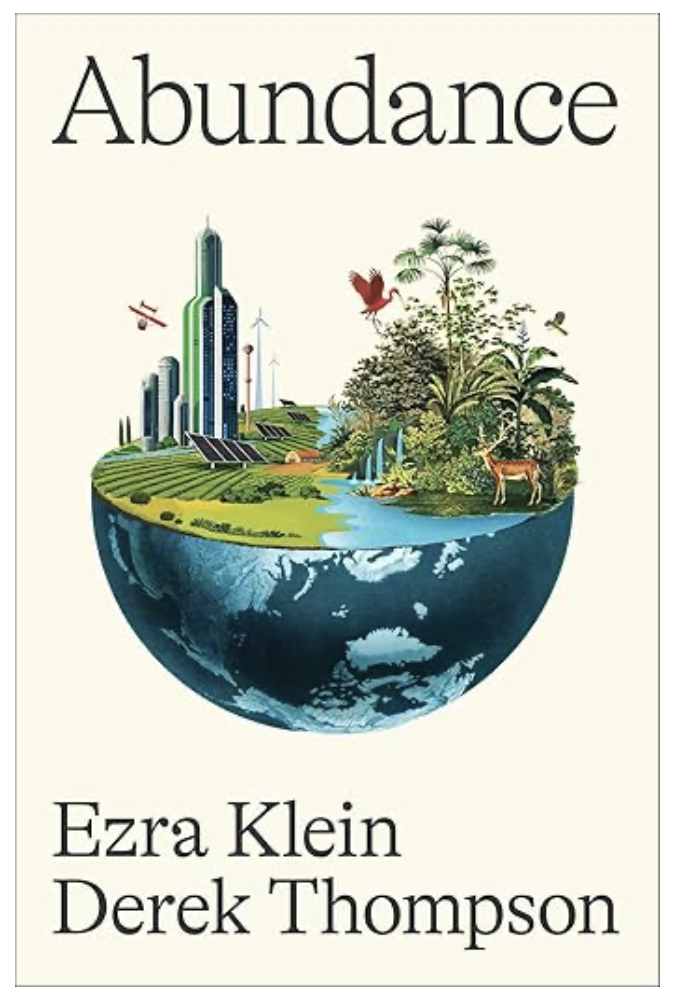
Screenshot 2025-03-22 at 9.59.09 PMSo it isn't surprising that I resonate with the general thrust of a recently published book by Ezra Klein and Derek Thompson, Abundance. In fact, I just ordered the book. Here's the Amazon description.

From bestselling authors and journalistic titans Ezra Klein and Derek Thompson, Abundance is a once-in-a-generation, paradigm-shifting call to renew a politics of plenty, face up to the failures of liberal governance, and abandon the chosen scarcities that have deformed American life.
 
To trace the history of the twenty-first century so far is to trace a history of unaffordability and shortage. After years of refusing to build sufficient housing, America has a national housing crisis. After years of limiting immigration, we don’t have enough workers. Despite decades of being warned about the consequences of climate change, we haven’t built anything close to the clean-energy infrastructure we need. Ambitious public projects are finished late and over budget—if they are ever finished at all. The crisis that’s clicking into focus now has been building for decades—because we haven’t been building enough.

Abundance explains that our problems today are not the results of yesteryear’s villains. Rather, one generation’s solutions have become the next gener­ation’s problems. Rules and regulations designed to solve the problems of the 1970s often prevent urban-density and green-energy projects that would help solve the problems of the 2020s. Laws meant to ensure that government considers the consequences of its actions have made it too difficult for government to act consequentially. In the last few decades, our capacity to see problems has sharpened while our ability to solve them has diminished.

Progress requires facing up to the institutions in life that are not working as they need to. It means, for liberals, recognizing when the government is failing. It means, for conservatives, recognizing when the government is needed. In a book exploring how we can move from a liberalism that not only protects and pre­serves but also builds, Klein and Thompson trace the political, economic, and cultural barriers to progress and propose a path toward a politics of abundance. At a time when movements of scarcity are gaining power in country after country, this is an answer that meets the challenges of the moment while grappling honestly with the fury so many rightfully feel.

 
Klein was on Bill Maher's HBO show this week. Maher hasn't been shy about criticizing California's overregulation, appropriately griping about how it took him three years, I think it was, to get approval for a solar panel installation on his house.
 
There was talk about how California has been trying to get high speed rail installed between Los Angeles and San Francisco for, roughly, forever. Now the plan is just for a segment between Merced and Bakersfield, if I recall correctly. Whoopee.
 
China has been able to build high speed rail hugely faster, as has the European Union. It does seem that Abundance is correct: the United States has lost its ability to build great things. Being old, and having grown up in California, I remember how quickly the interstate highway system in that state was built after a bill was passed by Congress in 1956.
 
Driving from central to southern California used to be really slow. Going through cities like Bakersfield involved stopping at lots of red lights. Once the I-5 freeway was built, and that didn't take very long, the trip was much faster and more pleasant. 
 
Here in Oregon, I'm a defender of our pioneering land use laws that protect farm and forest land from urban sprawl. But the downside is that our state lacks enough affordable housing. As was discussed on the Bill Maher show, blue states like California, New York, and Oregon likely will lose House seats after the 2030 census to rapidly growing red states like Texas and Florida.
 
Housing affordability is one reason. Red states have fewer regulations. Klein noted that this has caused Texas to have a lot of wind and solar electrical generation, even though the political climate in that state is anti-environment. The reason, according to Klein, is that the lack of regulation means green energy projects are easier to build in Texas.
 
Somehow us liberals have to find a way to build things that the United States needs without having construction slowed or even halted by onerous regulations. There's got to be a middle way between allowing development to proceed without necessary oversight, which the Trump administration is pursuing, and putting roadblocks in the path of development through over-regulation, which Democrat-controlled areas have been prone to.
 
The New York Times has a thoughtful review of Abundance, "Can Democrats Learn to Dream Big Again?" You should be able to read the review via my gift link. Excerpt:

As Ezra Klein and Derek Thompson write in “Abundance,” a guide for liberals shaken by an age of factional polarization, the United States can still blaze the path to progress, but only if progressives get out of the habit of putting obstacles in their own way. “If liberals do not want Americans to turn to the false promise of strongmen,” the authors write, “they need to offer the fruits of effective government.” But how?

Klein, a columnist and podcaster for The New York Times, and Thompson, a journalist for The Atlantic, are the best in the business at digesting and synthesizing expertise from a host of fields. “Abundance” expands on their previously published work over the last decade or so, and Klein and Thompson have no shortage of policy proposals on affordable housing (build more!), renewable energy (go nuclear!) and sustainable agriculture (vertical farming?).

But their book comprises more than a set of concrete steps to fix specific socioeconomic problems in America. It’s mainly a sharp cry against myopic Democrats who block new ideas and govern through checklists, leading to what the authors call “an endless catalog of rules and restraints.”


Discover more from Hinessight

Subscribe to get the latest posts sent to your email.

Comments

No comments yet. Why don’t you start the discussion?

Leave a Reply

Your email address will not be published. Required fields are marked *