

When I started watching The American Revolution on the Apple TV PBS app, I looked upon this as sort of a civic duty to see the newest documentary from the talented Ken Burns — especially since documentaries aren’t my first choice for evening entertainment.
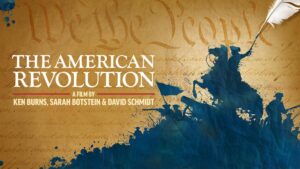
Well, six episodes and about 12 viewing hours later, my first impression was completely wrong. I was enthralled by every minute of the series, even though obviously there were zero photographs or videos of our Revolutionary War.
Burns and his co-creators skillfully wove together voiceovers, documents, commentary from historians, maps, battle plans, reenactments, and such into a thoroughly engrossing presentation that continually surprised me. I thought I knew at least the basics of what transpired in Revolutionary War times.
Actually, I didn’t. All I knew were shallow, and often incorrect, bits and pieces. Boston Tea Party. Paul Revere’s ride. Betsy Ross’s flag. Valley Forge. Washington crossing the Delaware. Articles of Confederation. Writing of the Constitution and Bill of Rights.
I was almost completely clueless about key subjects treated in The American Revolution:
- how it was as much a civil war between Patriots and Loyalists as a war against Great Britain
- how slaves were treated shabbily by Americans and much better by the British
- how George Washington made so many military mistakes
- how close the revolution came to failing
- how the Continental Army was plagued by mutinies of disgruntled soldiers
- how Native Americans were manipulated by both sides in the war, often in disturbing ways
Every few minutes I’d say to myself, “Wow, I never knew that.”
In school I got a highly sanitized simplistic view of the American Revolution. The larger truth actually was more inspiring, because the war was presented as it actually was: flawed people on both sides doing their best in an eight-year conflict that wasn’t a simplistic case of America good – Britain bad, but was considerably more nuanced.
The American Revolution was so skillfully made, I found myself getting nervous at times, anxious about whether America was going to come out on top. Since I was watching the series in the United States of America, I didn’t need a spoiler alert to tell me that we won the war. But The American Revolution had elements of a thriller where I wasn’t sure what was going to happen at key moments of the war, even though I knew the final outcome.
I doubt President Trump will be inclined to take the time to watch this series. He should. Because while The American Revolution shows the bright side of our nation’s founding, ir also shows the dark side. Our founders acted in ways that were both laudatory and shameful. Such is the nature of accurately reported history. Even great figures are a mixture of positive and negative, right and wrong.
To be patriotic is to see the United States as a beacon of democracy with serious flaws. The American Revolution makes clear that what began in 1776 is still a work in progress. Importantly, we aren’t a nation ruled by a king. Sorry, Donald.
I highly recommend that you watch this show if you haven’t seen it already. The price is right: free.
Discover more from Hinessight
Subscribe to get the latest posts sent to your email.