

It warms my heart to behold the recently released Pac-12 football schedule for the 2026 season.
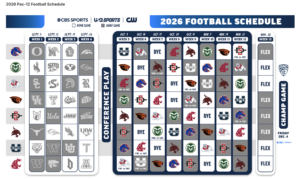
Back in November 2023 I wrote about how sad it was to watch the last Pac-12 Oregon vs. Oregon State game, as back then Oregon, Washington, Stanford, California, UCLA, USC, Colorado, Utah, Arizona, and Arizona State had announced they would flee the Pac-12 conference for greener (as in more media money) pastures.
That left Oregon State and Washington State as the sole remaining members of what had become the Pac-2. Things looked dark for OSU and WSU. But in December 2023 they got $255 million in a settlement agreement with the ten departing Pac-12 members.
Bouncing back, hard work and determination now has led to the Pac-12 having eight football members: Oregon State, Washington State, Boise State, Colorado State, Fresno State, San Diego State, Texas State and Utah State. As shown in the 2026 schedule above, each Pac-12 member will play twelve games. I don’t totally understand the Flex Matchup, even after reading the description on the Pac-12 website.
2026 Pac-12 Schedule Overview
- A four-game non-conference slate to begin the season over Weeks 1-4 (Sept. 5-26).
- A seven-game round-robin slate for league-play over an eight-week span, with one bye week each during that stretch from Weeks 5-12 (Oct. 3 – Nov. 21).
- A home-and-home flex matchup among the league’s eight football members to conclude the regular season in Week 13 (Nov. 28), which will be considered a non-conference matchup for standings.
Home-and-Home Flex Matchup
For 2026 and the league’s home-and-home flex matchup to conclude the regular season in Week 13, the Pac-12 will retain the right to adjust matchups based on the best interests of the league, including College Football Playoff (CFP) considerations at that time. Projected matchups for the final week on Saturday, Nov. 28, not to be confirmed until six days prior at the latest, include:
- Boise State at Utah State
- Texas State at Colorado State
- San Diego State at Fresno State
- Oregon State at Washington State
In any flexed format for Week 13 matchups, home teams will include Colorado State, Fresno State, Utah State and Washington State. The format ensures a minimum of six home games for each Pac-12 member as well as four home games each against fellow Pac-12 opponents. Further considerations will be taken into account should any flex occur among the stated projected matchups, including no team returning to the same venue twice during the regular season.
Today sportswriter John Canzano shared an inspiring story of the Pac-12 revival on his The Baldfaced Truth substack (I’m a subscriber). Here’s how “Pac-12 refused to just ‘go away'” starts out.
They were told to go away.
To give up.
“Why even bother to try?” the naysayers said.
Oregon State and Washington State were ditched by 10 departing legacy Pac-12 members, marginalized by the establishment, and left to sift through the wreckage alone.
A lawsuit before that folksy judge, Gary Libey, in the Whitman County Courthouse. A $255 million settlement. I’ll never forget having breakfast with Commissioner Teresa Gould at a diner in Salem a couple of football seasons ago and watching her talk about the fight for survival with glassy eyes.
“Coffee,” Gould said to the server, “and please, keep it coming.”
So it must have been some measure of satisfaction for those involved at Pac-12 headquarters to release the 2026 football schedule on Wednesday. The conference did it with an “After Dark” twist, bucking conventional public relations strategy with a 6:30 p.m. reveal.
There was much more at play here, wasn’t there?
The schedule includes eight football-playing members in a round-robin format. It has a “flex” scheduling option in Week 13. I looked at the schedule, but in the back of my mind, I had one recurring thought — the Pac-12 is like a cockroach, crawling out of a nuclear holocaust.
It refuses to die.
One Saturday morning, not long after Oregon and Washington left for the Big Ten, my phone rang. I was on vacation in a coastal town. The person on the other end of the phone was a ‘Power Four’ commissioner who was steamed that OSU and WSU wouldn’t simply accept relegation, go away, and join the Mountain West.
Throw in the keys?
It must have crossed the minds of officials at both schools. Oregon State’s football coach, Jonathan Smith, ran for the hills, stopping to drop his gear at Goodwill on the way out of town. There was a mass exodus in Pullman. WSU’s athletic director, university president, head football coach, and basketball coach all left.
Gould climbed aboard the Titanic and slipped into the captain’s chair. She’s since raided the MW for five schools, landed Gonzaga, added Texas State, negotiated three media rights deals, hired a deputy commissioner, and released her first football schedule.
Gould will celebrate her second anniversary on the job next week.
“It’s surreal sometimes,” she told me on Thursday.
This Pac-12 isn’t the old Pac-12. The Ducks and Huskies are gone. The league doesn’t have the Arizona schools or Cal and Stanford. USC and UCLA are rummaging around the Midwest. But this Pac-12 does have a group of recklessly hopeful schools that have a fun blend of survival instinct and ambition.
Discover more from Hinessight
Subscribe to get the latest posts sent to your email.