

Thanks to an article in TIME magazine by Meehika Barua, “The Rise of the Placeholder Partner,” recently I learned about placeholder relationships. Barua explains what this means in her opening paragraphs.

A friend of mine got out of a six year relationship, only to have her ex marry someone new within six months. Another woman I met at a networking event recently has been with her boyfriend for a decade, waiting on a ring. Every time they go on a vacation, she wonders if this holiday will be the one where he will propose, only to be dejected on the flight back home.
I never had the heart to tell these women they were placeholders.
According to social media, a placeholder partner is good enough to date, live with, or even spend years alongside, but never the person their partner actually plans to commit to in the long term. They’re the “in the meantime” partner, until the real one comes along. And now, when I date, it is one of my biggest fears: to end up as a placeholder.
Pop culture is full of cautionary tales about time spent waiting for commitment. On her 2024 album The Tortured Poets Department, Taylor Swift reflects on the frustration of investing her youth in a six-year relationship with Joe Alwyn that never progressed toward lifelong commitment. The lyric “I died on the altar waiting for the proof” in “So Long, London” is widely read as her reckoning with years lost to inertia.
A similar contrast emerged after Vanessa Hudgens ended her nine-year relationship with Austin Butler and later married Cole Tucker, who proposed within three years. The difference was clear to many of her fans, who pointed out that the right person wouldn’t make someone wait a decade for a proposal.
Why do women stay in long relationships when their partners have shown no signs of commitment? Often, people stay because they have invested so much of their time, love, energy, and focus into the relationship that they imagine a potential life with their partner. Most people don’t want to start another relationship because they’re terrified of being alone. This is a deeply human fear.
When I read Barua’s article in the print edition of TIME, which varied some from the online version, I couldn’t help but think of how my wife, Laurel, and I came to be married. While we were about the same age when we met, around 40, I’d just gotten divorced after 18 years of marriage and Laurel had never been married.
So I’d been out of the dating game since my college days, while Laurel had been in a series of relationships for the same length of time. No matter. I described our quick path to marriage on March 17, 1990 in a blog post, “14th anniversary — take that, Dr. Laura!” (In a few days, it will be our 35th anniversary.)
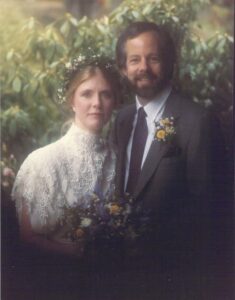
The photo above shows two people who had known each other for about eight months before they got married. And I proposed to Laurel after only about three or four months. The exact date is lost to my memory, probably in part for psychic protection reasons, because the proposal was embarrassingly unromantic and incoherent, being more a spontaneous outflowing than a carefully-planned event. About all I remember now is that when I was through speaking what I thought was a proposal to Laurel she looked at me and said, “Did you just propose to me? I’m not sure.” Poor girl. After forty years of being single, she deserved better.
Back in 1990 I listened now and then to Dr. Laura Schlesinger on the radio, she who would “solve” complex personal problems phoned in by desperate listeners with a few glib, preachy commandments. One of her oft-heard Relationship Tenets was that no one, absolutely no one, should commit to a serious relationship, not to speak of getting married, until some ridiculously long time had passed after a divorce—a year, I believe, maybe more. The notion seemed to be that a person can’t think straight, or trust their feelings, until some sort of lengthy psychic cleansing/healing process has taken place, which can’t be rushed.
…There are no rules in love. Laurel and I have proved that. Almost as soon as I met Laurel I knew that she was the woman I had been wanting all my life. And she still is, fourteen and a half years later. How long does it take to recognize the One? No time at all. That’s why she, he, or it is the One. Everyone or everything else is a pale imitation, shadows without much substance.
So here’s my advice: if you happen to be reading this, and you’re confused about where to go with a personal relationship, don’t listen to supposed experts. Well, you can listen to them, just as you can listen to friends, family, acquaintances, and strangers you meet on the street. But don’t trust them. Listen to your heart (note: the heart is above the sex organs, and speaks to you in a different language, that of love, not lust). You might make a mistake, but at least it will be your mistake, not someone else’s. If you’re going to be a fool in love, be your own fool, not Dr. Laura’s fool, or some counselor’s fool.
Since I proposed to my wife just a few months after we first met, and now we’ve been married for 35 years, this goes a long way toward explaining why the notion of a “placeholder relationship” makes no sense to me, personally. Meaning, I understand why many men, and a smaller percentage of women, enter into a relationship as just a temporary landing spot until a lasting connection with someone else can occur.
But that’s just an abstract understanding. My lived experience is of commitment. Sure, my first marriage came to an end after 18 years, rather than “til death do us part.” That divorce, though, didn’t sour me on marriage. It made me yearn for a more intimate bond with a woman. After we met, Laurel and I did a heck of a lot of talking. About life. About love. About what we wanted in a relationship. About so many other things.
It doesn’t take years to get to know someone. It only takes that long if one or both people in a relationship are holding back, unwilling or unable to reveal who they truly are. Laurel and I were confident that we knew each other very well after just three or four months. Of course, we’re still learning about each other, because each of us is constantly changing.
I feel for those who are in a placeholder relationship. All I can say is, have faith that the real thing will come along. Believe in lasting love, and it is more likely to happen.
Discover more from Hinessight
Subscribe to get the latest posts sent to your email.