

The story keeps getting more interesting of how the Salem City Council is spending $200,000 to conduct additional tests for dioxin and other nasty chemicals in and around heavily used Riverfront Park.
Yesterday I blogged about a "New City of Salem 'corporate welfare' giveaway to Mountain West Investment." It bothered me that public urban renewal funds were being used to test for contaminants on private land that is now, and will remain, owned by Mountain West Investment.
I could understand why the City wanted to test for pollution from the old Boise Cascade operations on the 3.8 acres west of the railroad tracks. Mountain West has agreed to sell this part of its property to the City so it could be added on to Riverfront Park.
But, I wrote:
There's more to this issue, though. Now I've got even more questions about how City officials are handling this issue.
First, the City Council, Mayor, and City Manager discussed the additional $200,000 worth of environmental testing in a closed executive session. A consituent of Councilor Laura Tesler asked her to explain why taxpayers were paying for testing on Mountain West Investment property.
Tesler replied that since this was discussed in an executive session, she couldn't say anything about the meeting. So Tesler told the constituent that she'd try to get information from City staff.
Now, I don't think it is a wild, crazy, Green-freak, eco-zealot notion to expect that discussions about possible dioxin and other contamination adjacent to or in a public park should be completely open to the citizenry.
The only reason I can think of why this was discussed in a closed executive session is that confidential matters relating to Mountain West Investment business plans and financing were talked about.
If so, this fits into my "corporate welfare" conspiracy theory. If not, what other reason would there be to shut out the public and press?
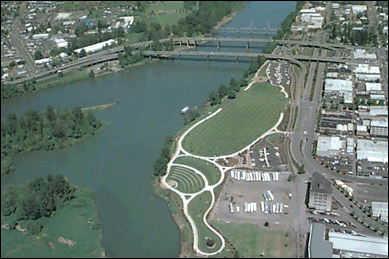
Second, contrary to the impression given in Statesman Journal stories, most of the additional testing is being done on RIverfront Park land already owned by the City, and already used by the public. I'd wondered how finding an underground pipe on the railroad right of way adjacent to the 3.8 acre planned purchase could boost the cost of DEQ testing from $150,000 to $350,000.
Testing is required by the Department of Environmental Quality before it will issue the Prospective Purchaser Agreement (PPA) sought by the City of Salem. A PPA limits the liability of someone who purchases previously contaminated land — sort of a "clean bill of health" guarantee.
But a PPA only is granted for land that hasn't already been purchased. So this part of a Statesman Journal story isn't accurate.
Download Salem council to pay for more environmental studies
The council agreed to use $200,000 in urban renewal funds for the environmental work. The environmental studies are needed to protect the city's interests, as it prepares to buy 3.8 acres for an expansion of Riverfront Park, city officials said.
This can't be true, given what John Wales, the City's Urban Development Director, said in an email message to the Councilor Tesler constituent (full message can be found in a continuation to this post).
The proposed new tests along the banks of the Pringle Creek and the Slough will be paid with Urban Renewal funds from the Downtown Riverfront and South Waterfront URAs. Of the 19 proposed test sites, four are located on/or adjacent to the 3.8 acre Park Parcel while the remaining 15 are located on the edge of Riverfront Park.
Thus only four of the 19 tests appear to be needed for the Prospective Purchaser Agreement.
Fifteen are on current Riverfront Park property. Meaning, City officials are concerned that there could be dioxin and other contaminants on the banks of Pringle Creek and the Willamette River Slough that are already accessible to park users.
This raises some questions:
(1) How did City officials become aware that part of Riverfront Park could be contaminated by noxious chemicals? How long have they known this?
(2) Given that Riverfront Park has been converted from a former Boise Cascade industrial site, was adequate environmental testing done before the property became a public park? Why is the shoreline testing only being done now?
(3) Won't the footings for the soon-to-be-built Minto Brown Pedestrian Bridge disturb the ground in the area of the 15 Riverfront Park test sites? Will this increase the cost of the bridge, if contaminants are found?
(4) Why are urban renewal funds being used to pay for the entire $200,000 worth of environmental testing, since only about $42,000 of that amount (4/19 of $200,000) apparently is for test sites related to the Prospective Purchaser Agreement sought as part of the deal to buy 3.8 acres from Mountain West Investment for an addition to Riverfront Park?
Regarding that last question, I'm no expert on urban renewal. But I've always thought it had to do with improving rundown areas and changing their character, not maintaining what already exists in a city.
Most of the $200,000 is being used to test for contaminants in an existing city park, Riverfront Park. Expenditure of that money seemingly has little or nothing to do with the proposed purchase of the 3.8 acre addition to Riverfront Park. It seems to me the 15 test sites should be considered park "maintenance," while the four test sites related to the new potential park acreage is "renewal."
[Update: I just noticed that this agenda item for the Urban Renewal portion of the September 8 City Council meeting claimed that the entire $200,000 is needed to complete the purchase of the 3.8 acres. This seems decidedly misleading. How is testing for contaminants on property the City already owns, which have no way of affecting the 3.8 acres (being downhill and downstream of the 3.8 acres) needed for "environmental due diligence" regarding the proposed purchase?]
Recommended Action: Approve the grant agreement, attached to the staff report, to provide $170,000 of Riverfront-Downtown and $30,000 of South Waterfront Urban Renewal Area funds, a total of $200,000, to the City of Salem for environmental due diligence necessary to acquire 3.8 acres of land adjacent to Riverfront Park.
I look forward to learning how City councilors and other officials answer these questions. If I don't have an accurate or complete understanding about what is going on here, I'm open to being educated.
Comment away on this post, City leaders. (I'll send them a link.)
Here's the complete message from John Wales, and my reply to him.
——————————–
Good afternoon Mr _______. Councilor Tesler has forwarded me your e-mail and asked that I reply.
As you know, the City is in the process of acquiring a 3.8 acre parcel adjacent to the Southwest edge of Riverfront Park (referred to as the "Park Parcel"). The City conditioned its acquisition of the Park Parcel on obtaining a Prospective Purchaser's Agreement (PPA) from the Oregon Department of Environmental Quality (DEQ).
The PPA is intended to protect the City from future liability from third parties that may arise from activity that occurred prior to the City's ownership. Obtaining the PPA to acquire the property is a discretionary action for the City, not a requirement.
The City has, therefore accepted the PPA cost as part of its due diligence. It is the same process the City used and paid for last year for the acquisition of the 300 acres at the northern end of Minto Brown Island, and is consistent with best practices when acquiring property that has a documented history of industrial use.
During the due diligence process, two new facts have emerged. First is the identification of an underground pipe that parallels the RR tracks and ends at the top of the north bank of Pringle Creek. This pipe appears located entirely within RR right-of-way and not on the property the City is looking to buy, although it most likely was physically connected to the former industrial buildings on the Park Parcel.
Although the pipe appears capped, elevated levels of contaminants, including dioxin, were found in the soil below where the pipe ends on the north back [bank?] of Pringle Creek. Former and existing property owners including Mountain West, BNSF [the railroad], and Boise are working, under DEQ's guidance, to conduct further testing, removal of the pipe and the associated clean up of the site. The work and associated costs are bourn by those parties, not the City.
DEQ has indicated the pipe and associated conditions must be addressed before issuing the PPA on the Park Parcel to the City. This includes soil testing along Pringle Creek to determine if there is any contamination in that area.
In addition, the City has learned of an old piping system that once extended from the old Boise bleach plant, crossed the southern portion of Riverfront Park, and drained into the Slough. Although it appears the pipes from this old system no longer exist, both the City and DEQ feel it necessary to conduct soil samples along the bank of Riverfront Park near the confluence of Pringle Creek and the Slough. Even without the acquisition of the 3.8 Park Parcel, the City believes it important to conduct these tests along the banks of Riverfront Park to address any potential public safety concerns.
The proposed new tests along the banks of the Pringle Creek and the Slough will be paid with Urban Renewal funds from the Downtown Riverfront and South Waterfront URAs. Of the 19 proposed test sites, four are located on/or adjacent to the 3.8 acre Park Parcel while the remaining 15 are located on the edge of Riverfront Park.
John H. Wales
Urban Development Director
City of Salem | 350 Commercial NE | Salem, OR 97301
(503) 588-6178 x7586
——————————-
Discover more from Hinessight
Subscribe to get the latest posts sent to your email.