

My wife was seriously angry at United Airlines. But she did a pretty good job of keeping her cool when she talked with a customer service representative late on a Saturday night.
"I've just spent several days planning a family reunion. Tonight I finally figured out the best United Flights to take between Portland, Oregon and Lexington, Kentucky. I'm using frequent flyer miles to go one way, and will be paying cash for a ticket the other way.
It was tough to find a flight where I could use the frequent flyer miles, because you have so many restrictions on them. But earlier tonight I made a reservation. I then went to buy a ticket for the return one-way leg and found that the price had jumped more than $250 in just an hour or two.
What's going on? This seems unfair. How can you guys change your prices so quickly late on a Saturday night?"
The answer she got wasn't very satisfying.
Prices, the representative told her, can change minute by minute. "Maybe somebody bought several tickets on the flight you want. There may have only been a few seats left at that price."
"But there were lots of seats still available on the flight," my wife replied. "It just doesn't seem right that you can raise the price of a ticket so much and so quickly after I had spent a lot of time planning my trip."
Well, this seems to be par for the course for not only United Airlines, but seemingly all airlines these days. So says an informative CheapAir article, "Air Fares 101: Why Do Fares Change All the TIme?"
The airlines want to be able to have their cake and eat it, too, and they go to great lengths to make that possible. They employ a very high-tech strategy called yield management which intentionally aims to charge different prices to different passengers in order to maximize the total revenue collected for each departing flight.
…Airlines never just have one fare – they have several, even dozens, of fares for each seat and they employ sophisticated techniques to maximize the number of people who get stuck paying the higher of those fares.
…It’s actually even more complicated in practice. Airlines actually have computer programs that are constantly monitoring flights, analyzing booking patterns, and in real-time changing the number of seats available at each fare level. If a flight is booking up faster than expected, an airline may decrease the number of seats available at some of their lowest fare levels, or wipe them all out altogether. If a flight is not selling well, suddenly more seats may appear at fare levels that were previously “sold out”.
Amazon also engages in this sort of dynamic pricing, according to an article in the Portland Oregonian. But that strikes me as more justified, since usually there are multiple sources of something you want to buy online.
Airline travel, though, often is exceedingly uncompetitive.
United basically has a monopoly on decent flights between Portland and Lexington, "decent" being defined as not making a jillion stops and arriving/departing at a halfway desirable time. So when United raised its price by about $250 less than two hours after my wife had checked on the flight, she really didn't have any other airline alternative.
Fortunately, by morning the price had dropped from $800-something to $628 (still higher than the $605 shown the day before). Who knows why? Only the United Airlines computers, and they're not telling.
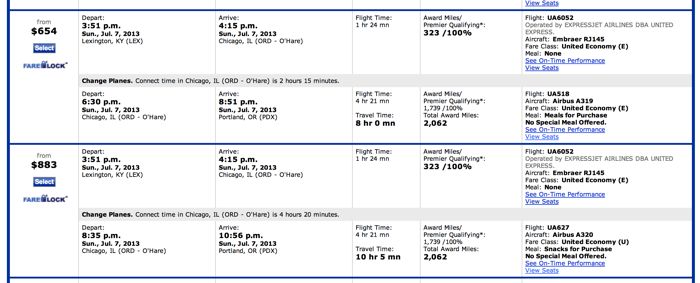
Before writing this post I checked on the cost of the flight. It's about the same, $654 now. But I noticed that a return flight to Portland on the same plane from Lexington, connecting with a plane that leaves two hours later from Chicago, costs $883 for an economy ticket. I think that's the price United briefly wanted on the night my wife got so irritated at the airline.
So what gives? Why does it cost $229 more to fly on the same plane from Lexington to Chicago to Portland, if you connect with a Chicago flight to Portland that leaves two hours later than another plane?
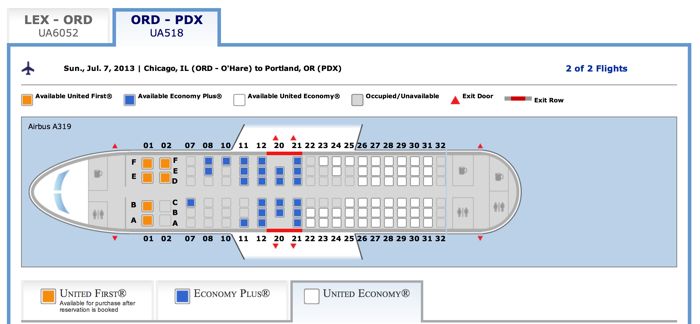
I took a look at the remaining seats for UA 518, the $654 flight, and UA 627, the $883 flight. At the moment there are 49 economy seats available on UA 518, the flight from Chicago to Portland (an Airbus 319).
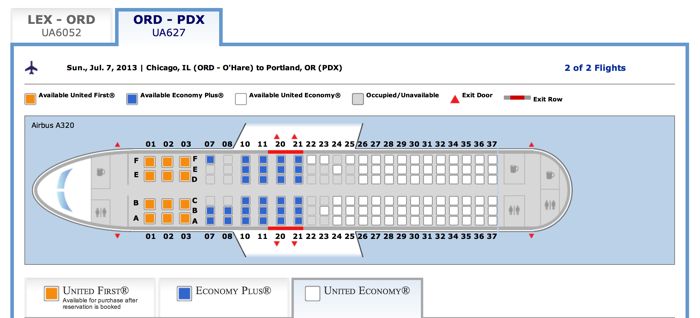
On the slightly larger UA 627 (Airbus 620), there are 77 economy seats available. Yet United is charging $229 more to fly on this plane from Chicago to Portland. On a Sunday, so the difference in price can't have anything to do with the schedules of business travelers.
And if it is holiday (Fourth of July) related, why would United charge $229 more for a flight that gets into Portland two hours later, since you'd think that most people would want to return home earlier given that Monday is a school/work day.
Prices for airline tickets just don't make sense anymore.
Not to the customers paying for them. I'm sure somewhere in the complex computer code of the United Airlines reservation system there's a well-defined reason for each and every price change.
Which doesn't make the seemingly arbitrary pricing less irritating. I'd love to fly on an airline that treated its customers fairly, openly, and respectfully — both in how it sells tickets and treats you while on a flight.
But so far as I know, that airline doesn't exist. Not in the United States, at least.
Discover more from Hinessight
Subscribe to get the latest posts sent to your email.
UA 627 is a Premier Select (Ps) flight, so all of the seats are Economy Plus, Business class or First class.
The fare difference is likely the difference between Economy Plus and Economy. The benefit of the Ps flight is that it still tends to be business travelers and you can use miles to upgrade to Business class.
Unfortunately, that doesn’t help your wife, but I hope she enjoys her trip anyhow.
This frustrates and angers us, but really, it is simply the law of supply and demand at work- albeit in a quickly-responsive way.
If you go to your local store and see an appliance priced at $599, and it sells out very quickly,
you might very well find that a month later, that store has raised the price to $699 because
they know there is a demand for the item.
That’s all the airlines are doing. The difference is that their “product” is a seat on a flight so there is a very short window of time to assess demand and adjust prices. Unlike the appliance,
rapid selling of seats indicates demand and means that the airlines needs to raise the price NOW if they are to capitalize on it. Letting it go and raising the price on “the next flight”, even if it’s the exact same flight one week later, doesn’t cut it, because there is no guarantee at all that the demand will be the same. The demand for a flight varies wildly depending on the date of the travel.
I’ll go you one better…. How many times have you started reserving a flight through an on-line service like Travelocity, at one price, only to find that just as you are ready to click “confirm”, the price goes up?? Yep… They are seeing a big demand on that flight and they are adjusting the price as instantly as they can.
It’s not very nice, and can be very painful for us, the consumer. But it’s like anything else.
They charge what they can get based on demand.
When i was booking my flight for $191 and error came up, I went back to the site immediately and now my ticket was $240!!
I will not travel with United anymore.