

We're always learning something new about country living. Today, it was that our 440 foot new well, just three months old, can quickly accumulate 60 feet of silt.
Who knew?
It surprised even our well driller, Troy, who said that in his experience he's only had a couple of ten inch wells manifest this odd behavior. Unfortunately, it was our well and the next one he drilled.
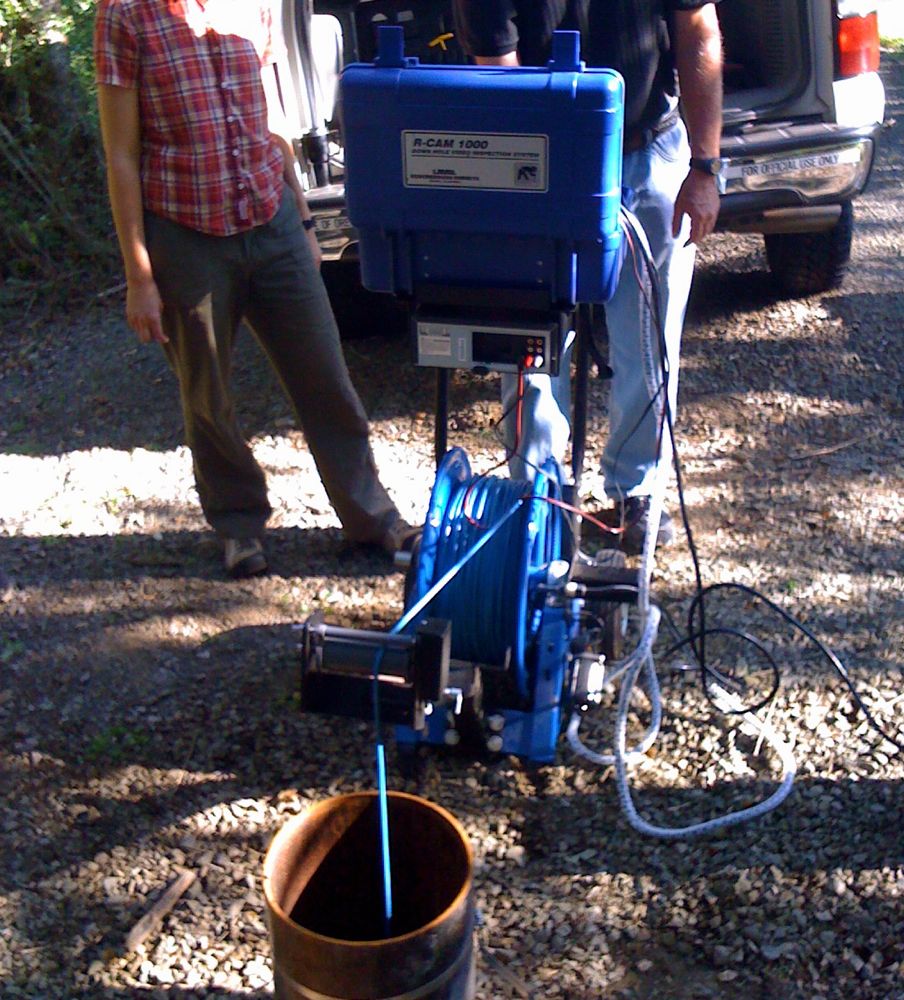 Unlucky us. But at least now we know what's going on, and how to fix the problem, thanks to some down-the-well diagnosing with a submersible camera.
When Oregon Pump came by a few weeks ago to install a pump in the new well, they found that a probe couldn't get anywhere near the bottom. Since the well has a liner all the way down, that surprised us.
The slots in the liner where water flows in are only 1/8 of an inch wide. We couldn't understand how so much debris could get into the liner from the sides of the well, especially since we hadn't been using it, so no water was moving up and down.
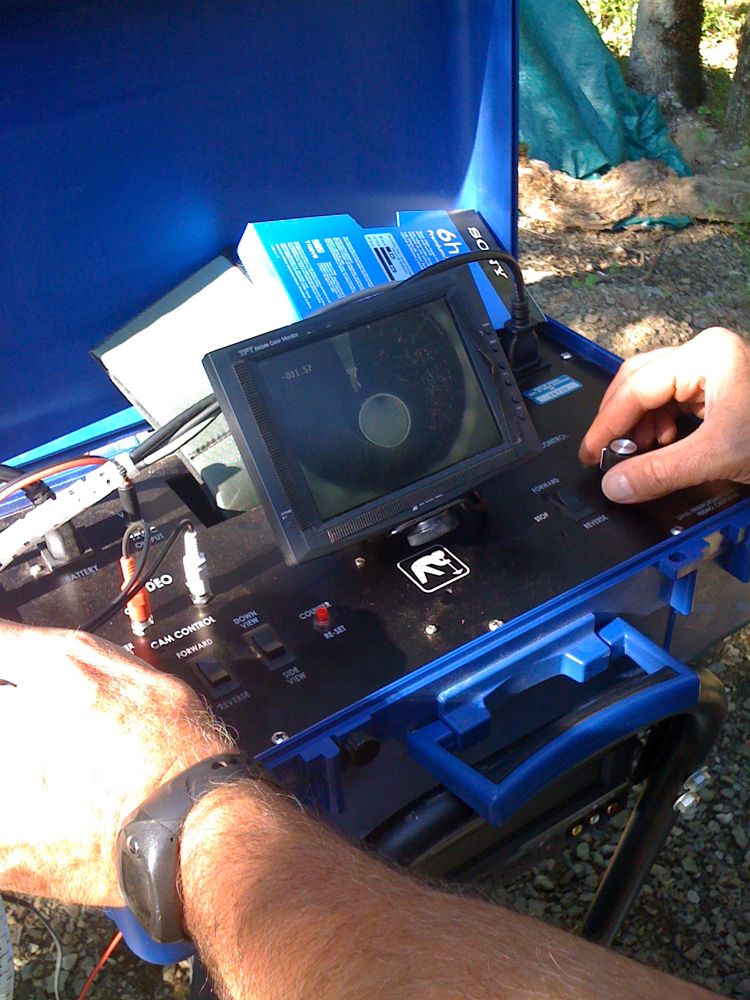 Since there was a possibility that the liner had collapsed, we decided to take a look down the well. It was interesting to watch the viewing screen as the camera slowly descended down the liner.
When it got to about 380 feet, we hit pay dirt. Or rather, dirt that we'd paid to have removed, but was still in the well. This wasn't Troy's fault — just one of those things that happens in well drilling, and thankfully it's fixable.
 The camera's probe descended into the muck a bit, showing that it was very fine, not at all solid. When the camera came out of the well, the operator honored my finger with some of the silt.
It was slimy rather than rocky or dirty. Tiny particles were evident in it. Troy explained that this is probably what happened:
After he enlarged the well to ten inches (we started with a six inch well), he let the water settle for a day. Then he put the liner in — 20 foot lengths of perforated PVC pipe, glued together.
He had no problem getting the liner all the way down to the bottom, so the well obviously hadn't silted up right away.
Troy figures that the large ten inch well must have contained a lot of fine particles that were still floating around in the water (about 1800 gallons worth) even after a day of settling. Water was both inside and outside of the liner.
So most of the silt, or sediment, was already inside the liner, and simply settled to the bottom eventually. Likely there also is sediment outside the liner also, between the pipe and and the walls of the well.
Troy is going to rent a sediment pump, take out the liner, and then remove the silt. He explained how the pump works, but I'm incapable of re-stating the mildly erotic details of the suction process.
This should restore our well to close to 440 feet deep. Certainly much closer than we are now. The pump will be installed 20 or so feet from the bottom, in case some silting reoccurs.
I wanted to tell our story in case someone else has a similar problem, and finds this blog post via a Google search. This amount of silting isn't common in a new well. Doing my own Googling, I couldn't find any obvious references to what happened to us.
But not many residential wells are ten inches in diameter. There's three times as much water in a ten inch well as in a six inch well, so seemingly there also would be three times as many floating particles.
It's still difficult to picture how those particles could end up silting up 60 feet of a six inch liner. Yet the camera showed that this is what we've got.
(If you are a city dweller who reads this post, out of boredom or some other reason, be thankful that all you need to do is turn a faucet and water comes out. We love living in the country, but at times, like today, a condo with a couple of potted plants on the deck sounds pretty appealing.)
Discover more from Hinessight
Subscribe to get the latest posts sent to your email.
Ah, the joys of wells. The first place we owned in Oregon had a good well when we bought it producing 40 gallons per minute. Enough to brush our teeth, wash the dishes and irrigate 7 acres of hay as long as we didn’t overdo it..the tooth brushing that is.
There was an earthquake in Klamath Falls (over the mountains from where we lived outside of Medford) that many people thought caused a shift in the ground water tables. Some people lost well production and others gained.
We started noticing sand in our tap water and had the well checked. We were shocked to find that the wells production had dropped to less than 1 gpm.
This was bad for several reasons, one being that we had buyers for the property as long as the well produced at least 10 gpm.
The well driller went down 100 ft. No improvement. Another 100, 200, 300. Nothing. I’m starting to get nervous. Finally after going down about 500 ft. we got 9 gpm which the buyers accepted and we were outa there.
I had two other wells before we saw Oregon in the rear-view mirror. They were frequently a source of concern and expense.
I feel your pain.
Thx for sharing this post!It seems to me interesting to see a post related to “WELL”
Hello,
Can you tell me what pump you are using in your well and the gpm you are getting.
Thanks,
Ryan Maness
downinmexico.org
Ryan, we aren’t using any pump at the moment. It took a long time for our well driller to work out a way to get the silt pumped out without using his big rig, which would have re-damaged our yard. That was finally done.
Now we’re waiting to have a camera put down the well again, to check on the current non-silted depth of the well. We can tolerate 10-15 of silt, but hopefully the rest of it is gone. I’ll try to remember to leave another comment when our well is up and functioning.
Washington has, all of a sudden, become lenient on the subject of rainwater catchment and we are getting ready for phase one of developing a system that will, ultimately, back up our well with potable rain water. Phase one is two 2500 gal tanks to use for irrigation. Think of your rain tanks as a well. From the tanks you pretty much bring it to the house like you would well water, pumping and filtering as necessary. Plus, you can have either/or, well water or rain water. Cost is probably similar to the cost of a well.
Randy, that’s interesting — storing and using rain water the way you described. Makes a lot of sense. I have relatives who use a cistern at their residence in one of the Caribbean islands. I believe they use the rain water for everything, drinking, bathing, etc.
You probably have to drain and disinfect the tanks periodically, don’t you? That’s what we were told when we were considering the pros and cons of a 10 inch well versus a holding tank. We liked the idea of a maintenance free “holding tank,” which pretty much is what a larger diameter well is.
How do you collect the rainwater? Does it only come from roof runoff, or is there another source?