

If you have city water, you turn a tap and water comes out. Pretty simple.
Out here in the south Salem (Oregon) countryside, each house has an individual well. And that's where things get complicated.
Especially if you have super-crappy water, as we do.
It takes four large tanks in our garage — an ozonator, softener, iron filter, and ph adjuster — to treat our current well water and make it suitable for indoor use (outside, the plants love the raw water with its iron, magnesium, and such).
The equipment is sensitive, prone to breakdowns, and fairly expensive to maintain. So we've harbored fantasies of drilling a new well that would (A) supply us with a greater flow than the 10-12 gallons a minute we've got now, and (B) have higher quality water.
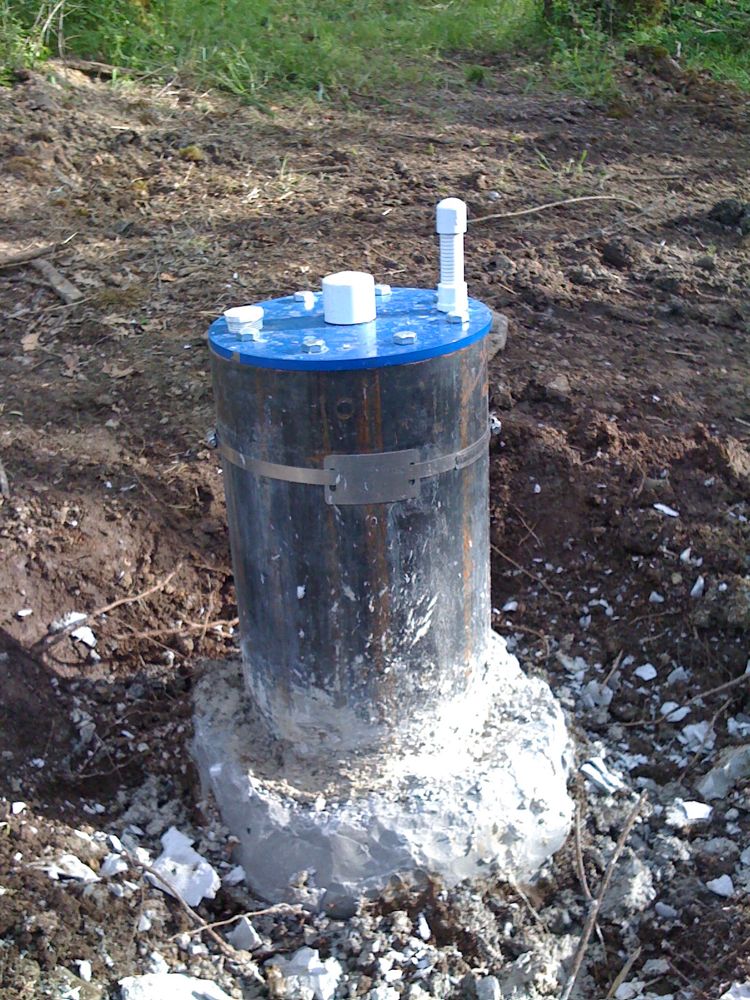 Here's the fantasy, fulfilled. Sort of. We got (B) but not (A). Well, you can't always have everything you want with a well.
Our driller, Troy, of All Seasons Well Drilling, reminded us that sometimes people get a dry hole for the thousands of dollars they fork out for a well. So we're thankful that our 445 foot hole turned out as well as it did (hard not to use "well" a lot when you're thinking about wells).
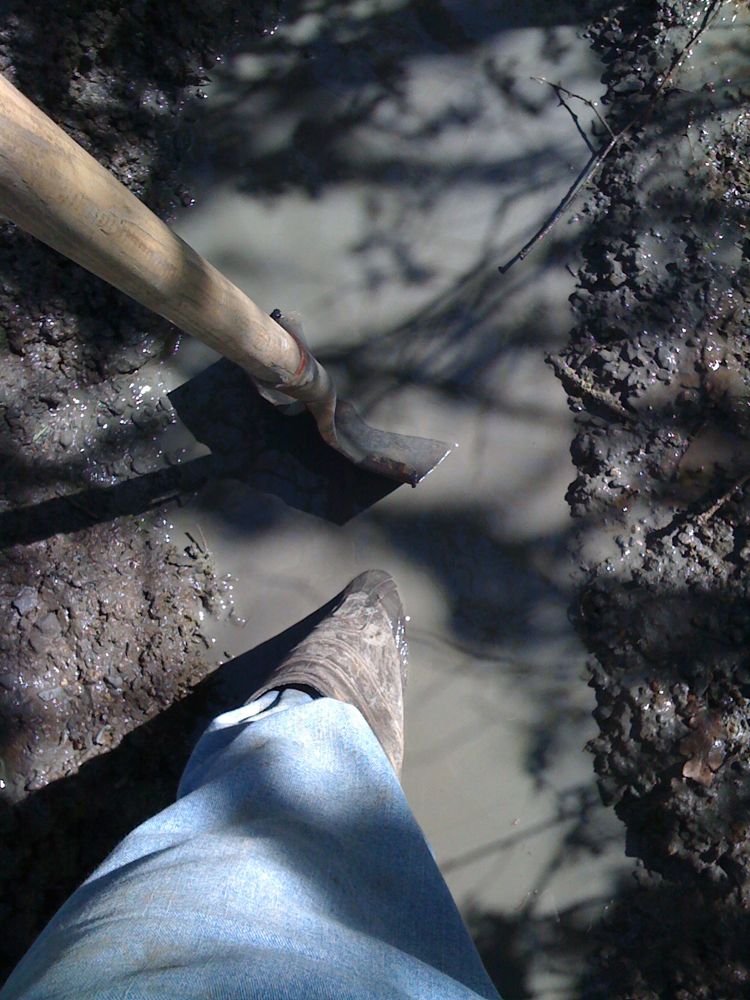 This is the first well drilling experience for my wife and me. We've learned quite a bit. And gotten to play in muddy flowing water like we were kids again.
A well looks so neat and clean when it's all finished, like in the first photo. But the process of drilling a well — messy! No way to avoid it, especially with a well that was widened to 10 inches.
Troy started with a 6 inch hole, which is standard in our neighborhood. He told us that he likes to do this, drilling down all the way without casing the top part of the well, because it lessens the cost if water isn't found.
Some drillers, he said, case (meaning, seal) the upper part — 53 feet in our instance — before knowing whether the well is productive. So people can be left with an expensive underground concrete or bentonite "flag pole" that has to be abandoned.
After we got down to 445 feet with seven gpm of better quality, but still fairly iron'y, water, we had to decide whether to widen the well to 10 inches. In various areas of life, including well drilling, there's a valid question: "is bigger better?"
We pondered the pros and cons of a six versus 10 inch well. And decided to go with bigger.
Troy educated us with some geometry. Each foot of a six inch well holds 1.5 gallons of water. Each foot of a 10 inch well holds 4.5 gallons, three times as much.
There's about 400 feet of standing water in the new well. So in our case a 10 inch well essentially serves as an extra 1200 gallon holding tank (a six inch well would hold 600 gallons; a 10 inch well, 1800 gallons).
Yes, it cost us more to widen the hole to 10 inches. Everything is more expensive when you go bigger: the drive shoe, the casing, the perforated liner (which extends from the upper casing all the way to the bottom of the well).
But we figured that if our water flow drops for whatever reason — global warming, over-development, well problem — it'd be nice to have a maintenance-free "holding tank" with plenty of storage for our household use.
(We'll probably end up using our old well for outside watering, in part because our garden plants love the mineral-rich water so much).
I'll attach a copy of our well log, which is public information, for any well geeks who enjoy looking at the detailed information.
Download Well log
Our current well, which was drilled in the early 1970s, doesn't have a liner. We like the idea of having a six inch perforated plastic liner from five to 445 feet down. The way we understand it, this keeps rocks and other debris from caving in and messing with the pump, or making the well unusable.
Here's a prime piece of advice for anyone who is having a well drilled: be aware that lots of muddy water, gravel, and such is going to flow from the drill rig and go…somewhere.
Water is injected into the hole as it is being bored. Then it is blasted out. Quite a scene, as the water/rock/dirt mix sprays out 15-20 feet or so. Think ahead about where it is going to end up.
We ended up digging a series of trenches to divert the muddy gravel/water mix away from our landscaping. Had to do it by hand, since there were too many trees and brushy vegetation to use a machine.
Troy, who worked by himself most of the time, handled the bigger trenching up near the drill rig. Laurel and I kept the water flowing in the right direction the rest of the way.
It wasn't a hugely horrible task, once we got it figured out. Gushes of muddy, gravel'y water would come flowing down the trenches when a new section of the well was drilled out.
We'd shovel out the gravel from areas that came close to overflowing. Mostly, the downhill topography kept the muddy mix moving along nicely into natural areas of our property.
After the well was finished, Troy scooped up a lot of muck with his tractor and buried it in an open grassy area. Believe me, you don't want this stuff hanging around any place you'll be walking. Or where you want vegetation to grow.
I don't know whether this is always the case, but what came out of our sandstone well was a lot like watery clay. Or quicksand, in the deeper areas. It stuck to our rubber boots like the mud that it was.
Anyway, that's a description of our first — and hopefully last — well-drilling experience. Now that it's over, I can almost say that it was fun. Almost.
While the drilling is going on, expect noise, mess, and a prodigious amount of muddy water. Remember the 1.5 and 4.5 gallons per foot rule for six inch and 10 inch wells, respectively.
With a 445 foot well, we had about 2000 gallons of mucky soil and rock that came from underground, and became part of our overground. Dealing with that stuff was the main thing we had to cope with.
Aside from writing some pretty large checks.
Discover more from Hinessight
Subscribe to get the latest posts sent to your email.
I am amazed at the difference a few miles has on water well quality.
We previously lived a couple of miles to the east of you. The water was the finest drinking water imaginable.
I am one that wakes at least once at night and has a small glass of water.
Every single time I had that drink of water I would think, “Damn, thats good!”
The other odd thing there was water quantity.
The old timers in that neighborhood claim that there is an underground lake.
The well drillers say that the GPM there was strictly related to casing and pump.
While living there a neighbor drilled a well and when he hit water the casing blew a guiser, 40′ in the air for hours.
The driller finally went home and let it settle down over night.
Up here on Skyline is a different story.
We have the best flow in the neighborhood at 17.5 GPM. Most wells here flow between 5 and 10 GPM and are also VERY DEEP!
There is one up here at 500’deep, 2GPM (so I’m told).
The water is good to drink. Way better than city rot-gut. In fact, when I travel to CA with the bees in FEB, I take a gallon for drinking water; their water SUCKS!
Anyway, we do have a bit of calcium in the water. Enough to cause quite a build-up in the hot water tank after time. Also, things need towel dryed to avoid water spots.
Now to the west of us is REALLY risky drilling territory.
They often hit salt water and then they are screwed.
In our neck of the woods 7 gpm would be considered a gusher. I don’t have enough flow to make a pressure washer work.
Hello, the latest technologies of drilling a new well that would supply us with a greater flow than the 10-12 gallons a minute we’ve got now, and have higher quality water.
Thanks
We was just informed that we have coliform bacteria in are Well, we share a well with the neighbor. We also live on a lake and because of the bacteria in the lake, so they put in grinders which replaced the septic’s. A lot of money for each person and $1500.00, plus 65.00 a month starting a year prior to the poop stations being done. Had to abandon the old septic and fill with sand or pea gravel; why they didn’t run city water at the same time doesn’t make since. Our neighbor’s transferred house is up for sale so they are doing all house inspection, we share the Well an it showed Coliform Bacteria and the well isn’t up to code, no cap so that has to be added and they are talking drilling a new well with submergible pump. The well is shallow, but we have canals where we live and one is nothing but gray water and you can pull a stick out and it will light like a torch from the gas and stinks. e freaked when we found out as I have Multiple Sclerosis and we don’t eat out because of unclean people serving you food not washing there hands. We have told many neighbor’s s they can get there well tested. We also think that there are septic’s that was supposed to be pumped and filled that wasn’t and that with all the rain we have had possible they are still having run offs into the ground and into the one Canal that is nasty a foot deep of gray water. Don’t know if there are grants to clean it out, but I know there has to be more than just the 2 houses with this problem, calling the health department tomorrow to see what they say!!! Glad I read your story. Thanks for sharing, We already Thanks again!!!