

How is AI going to affect art? This important question is addressed creatively, thoughtfully, and, yes, artistically, by Christoph Niemann in a special recent issue of the New York Times Magazine, Learning to Live with AI.
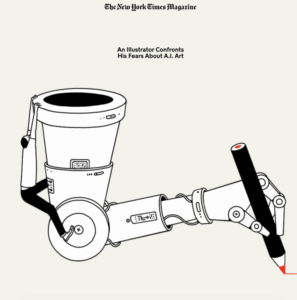
My wife subscribes to the Sunday New York Times, so I was able to see Niemann’s piece — a combination of sketches and words — in the print edition. Since I’m a subscriber to the digital New York Times, here’s a gift link to “Sketched Out” that should work for subscribers and non-subscribers alike.
To whet your appetite for reading/viewing the piece, I’ll share how it starts out, text-wise.
In my bedroom, pinned next to a mirror, are a few drawings that my kids made when they were 6 or 7: birthday doodles, strange stick figures, text riddled with cute typos. They are some of my most prized possessions.
But recently I asked myself: What if I found out that these doodles were actually made — or even just “enhanced” — by A.I.? Would I still treasure them?
The advent of A.I. has shocked me into rethinking my entire relationship with art.
Some of my colleagues are enthusiastic about the new possibilities. Most are skeptical. But no one doubts that A.I. will have a huge impact.
There are two parts of the discussion about creativity and A.I. that I consider most urgent. The first is about economics: Will people still be able to make a living making art?
And as that gets harder because of A.I., shouldn’t artists have the right to stop their work from being used to build the systems that destroy their livelihood?
The second question is more complicated — and more interesting. Is A.I. good or bad for the creative process? Making art is really, really hard. Who wouldn’t want to just tell a machine what you want, sit back, and receive a finished artwork in seconds?
The experience is dazzling — with a few caveats. The first is that I want my ideas to be original. A.I. algorithms (at least the ones we have so far) are fed huge amounts of existing art in order to create new concepts. This works well for variations of an existing idea, which admittedly is what the creative industry mostly wants. But for now, it struggles at making a truly original leap.
I’m totally unartistic. Even drawing stick figures is a stretch for me. But in about a minute I just used Grok Imagine, an AI “art” creator (the scare quotes are justified, given what I just created), using the prompt “cat dressed as pirate in hot air ballon floating over ocean with huge waves.” Behold! My “art”!?
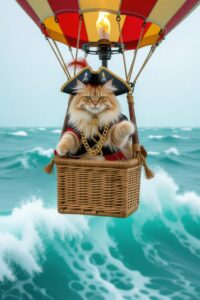
I don’t call this any sort of genuine art. It’s a cute trick that AI does, entertaining but in no way artistic. Anyone can create this sort of thing with Grok Imagine or other AI models. Sure, some of the prompts that people come up with are wonderfully creative, and it takes some skill to refine an initial concept into a more polished AI product over several iterations.
Such is the danger of AI, from my perspective as someone who is utterly incapable of creating art on my own. I don’t want unartistic people like me making it more difficult for actual artists to produce, share, and profit from their art.
What I am somewhat good at is writing. I’ve been writing since I was quite young. When I was 13, I composed a poem that said something to me. In fact, it still does. I wrote about this in a blog post, My grandmother taught me the power of “I like it.”
Look up to the heavens.
What is there? Tiny pinpoints of light.
But is that all?
Look past the stars into the blackness of the void.
What lies there, waiting for man’s first faltering steps into the darkness of the universe?
What unknown mysteries lie where human eyes cannot see?
In the darkness of the void, perhaps there are things we should not know, and not find out.
It isn’t a great poem. Not even a good poem. But it was my poem. It sprang into my young mind after I went into the yard of my rural home in the foothills of the Sierra Nevade mountains on a clear cloudless night.
An AI model could compose a much better poem. However, it wouldn’t mean much to me, because I view reading as a marvelous form of mind-reading. Along with the spoken word, and nonverbal art, the creations of a human being tell us something about the mind of the person who fashioned them.
I don’t want AI models to replace human creativity. My fear, though, is that this will come to pass, and worries like mine will come to seem like quaint attempts to hold onto the past, like those who resisted the demise of horse-drawn carriages when automobiles came along.
Discover more from Hinessight
Subscribe to get the latest posts sent to your email.