

Mathematics fascinates me in much the same way music does. I’m mediocre with both mathematics and music, and that’s being generous. Crappy with both probably is more accurate.
The most advanced math class I’ve ever taken was introductory calculus in graduate school. I passed the course, because I could do the basic calculations halfway well, but I never really grasped what calculus was all about. Something about infinitely tiny stuff, I seem to recall.
So since I’m a long way from grasping mathematics on my own, I enjoy reading non-technical articles that convey what the field means to those who practice it. Which is why I loved a piece by Rivka Galchen in the November 9, 2026 print issue of The New Yorker, “Proof of Concept: The year that artificial intelligence took over solving problems.”
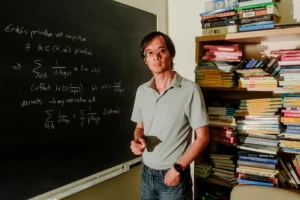
The online article is called “The Year Math Changed Forever.” Subtitle: A.I. is solving problems that stumped the field for decades. Mathematicians look to Terence Tao for guidance on their altered world. Photo above from the article is of Tao.
Here’s a PDF file:
The Year Math Changed Forever | The New Yorker
The main point I took away from the article is that math is much more than calculations, or finding solutions to complex math problems. It’s as much art as science to skilled mathematicians. Importantly, how a difficult math problem is approached is the crucial thing, since understanding is the goal, not just a correct answer.
That’s what concerns Tao, a math prodigy, and many of his colleagues. AI models are rapidly becoming adept at finding solutions to math problems that have stumped mathematicians for many years, decades even. However, the proofs supplied by AI are difficult to comprehend, if they exist at all.
So this is leading to a crisis in mathematics, given that how AI’s deal with math is so different from how mathematicians look upon their field. Here’s some passages from the article that will give you a feel for it. Reading the entire article, of course, is highly recommended. I enjoy using AI models such as Claude. But this article shows how risky the rise of AI can be.
“Ordinarily, I would use A.I. and create some fancy version of this,” Tao said, gesturing at the bare-bones graphic on the screen behind him. “I used PowerPoint,” he admitted, to laughter. He then described the current state of the field. Solutions were being published, often with little explanation or detail, relying on the good will and free labor of mathematicians to verify and illuminate them.
A.I.-generated submissions were overwhelming mathematics journals and databases, and the field’s genteel ecosystem of people volunteering their time to referee submissions was collapsing under the weight of slop. Sometimes even the person submitting the paper did not understand it. Answers were being found, but, in math, answers are often not very important; the insights and inventions that arise while working toward an answer matter much more.
“We have to slow down,” Tao said. “It’s insane, the pace.” During the Q. & A. portion of the talk, an audience member observed that A.I. has thus far been solving problems that already exist. Where did Tao think new problems would come from? New problems, Tao said, emerge from “the slow, deliberative process” of working toward a solution, “and this is what’s being destroyed.”
…Much of the math we learn as kids is mechanical, which may be why mathematics is sometimes misperceived as an unimaginative field. A more accurate understanding might come from recalling that Charles Dodgson, better known as Lewis Carroll, was a professional mathematician. In some ways, the writing of “Alice’s Adventures in Wonderland” resembles mathematical research. Mechanical calculation, in this analogy, is the basics of composition: spelling, subject-verb agreement.
But, in order to explore logic and whimsy and wonder and paradox, Carroll invented characters like the White Rabbit, the Cheshire Cat, and the Queen of Hearts, and situations like the Mad Tea Party and the Caucus Race. These characters and scenes are akin to the objects and techniques mathematicians invent as they explore mathematical ideas. When Andrew Wiles proved Fermat’s Last Theorem, more than three hundred and fifty years after its initial postulation, mathematicians were thrilled, but not because of the answer, which wasn’t surprising. (No, there are no positive whole numbers such that an + bn = cn if n > 2.) What was wonderful about Wiles’s proof was the mathematical techniques he’d developed along the way. That was what advanced mathematics.
But coming up with characters and story lines is challenging—which is probably why it’s satisfying. I sat in on a meeting Tao had with his postdoctoral mentee, Iqra Altaf, who was working on a problem in geometric-measure theory. “Mathematically, the news is not good,” Altaf said. She went to the chalkboard and began writing out a counterexample to a conjecture she had thought would prove true. “Math is like a video game, or like ‘Groundhog Day,’ ” Tao said. “Every time you die, you come back.” En route to failure, you learn something that aids you in the next go-around.
He quoted the Russian mathematician Vladimir Arnold, who once said, “Mathematics is the part of physics where experiments are cheap.” In another conversation, Tao compared learning mathematics to watching “Emily in Paris,” a show that he and his wife enjoyed. “It’s completely ridiculous fluff, but it’s also fun. You learn the tropes, and you can kind of see how it’s going to go,” he said. “But if you’re just given a synopsis of the plot, like, ‘Here’s the premise, and this is what happens’—that’s not the point.” And, if you want to learn how to write your own show, “then it’s not helpful at all.”
Seeing scenes done poorly and done well, watching how plots are resolved even in formulaic shows—that’s how you learn to direct your own series. Among the crises that the arrival of A.I. has brought to mathematics, “the most urgent one is, How are we going to train our graduate students?” Tao said. It is a question that he has been asking for several years. The modest-sized problems that graduate students would once have spent months on—learning to think mathematically in the process—can now sometimes be solved by A.I. tools in hours.
…An initial group of twenty-five Fields medallists, Tao among them, responded with an open letter noting that “solving problems is only a tool and proxy for achieving the primary goal of conceptual understanding and insight.” Problem-solving and insight were decoupling, it observed. “The letter was correct to call out bad behavior,” Williamson said. “But my broader sense is that I don’t think mathematicians had been grappling as much as we should have been with the impending reality of A.I., and I think that is somewhat visible in the letter. It’s a letter that reflects what was already a reality six months ago.”
Socrates is said to have worried that writing would ruin our memories—and Socrates’ crowd probably did remember longer stretches of the Odyssey than any of us do. But the Fields letter argued that the use of A.I. was not like merely off-loading the memorization of poems or phone numbers; it was more like off-loading, or bypassing, daydreaming and debating and thinking. It’s not that humans will come to know too much too quickly but that they will understand less and less—eventually less than we understand now. “The most precious resources of our profession are students and ideas, and these we nurture with great care,” the letter said. Mathematics is a living discipline and an oral tradition, not just a written one. The symbol of the working mathematician is a chalkboard, representing knowledge that can be erased after it’s understood because it is now in the mind.
…Mathematics “has been living a bit of a double life,” he suggested, and the pressure from A.I. was making that visible. To people outside the discipline, the story is that math is important and that, even at its most abstract, it often ends up leading to all sorts of unexpected applications, like public-key cryptography and G.P.S. “This is the story one tells when one wants grant money,” Urschel said. “But this story is not true. And it has never been true.”
Or, at least, it’s mostly not true. Urschel postulated that every mathematician sees himself as being somewhere on a spectrum between scientist and artist. “I would say what I call the more scientist approach is being focussed on trying to push the frontier of things as far as we can as quickly as we can,” he told me. “And the artist perspective is, Let me do something beautiful and enjoyable and manipulate these things, and the act of doing this is really, you know, a joyful thing.”
Discover more from Hinessight
Subscribe to get the latest posts sent to your email.