Strangest reason to legalize recreational marijuana in Oregon

With Oregonians starting to vote by mail on Measure 91, which would legalize recreational marijuana in this state, naturally I had to make this the theme of my most recent Strange Up Salem column in our alternative paper, Salem Weekly. (Feel free to give Strange Up Salem a Facebook "like." Strange is good. This town is under a blah-curse, and every Like lifts it a bit.) I called the piece, A Strange Reason to Legalize Marijuana.  I like it a lot. After the new issue of Salem Weekly hit the streets a few days ago, I re-read the column while…

Rick Steves tells Salem why marijuana should be legal

Not being much of a traveller, I'm kind of ashamed to admit that I'd never heard of Rick Steves before learning he was touring Oregon to talk about "Travel As a Political Act: Ending Marijuana Prohibition in Oregon."  Steves wrote a book with that title, Travel As a Political Act. His interest in making marijuana legal comes partly from his co-sponsorship of Washington state's successful 2012 ballot legalization measure. Last night my wife and were part of a packed house, 300 people or so, in downtown Salem's Grand Theatre. This photo was taken before the event started. Eventually the balcony…

Truth Bomb #5: Salemians were excluded from police facility planning

Here's a non-shocker: an elected official, in this case Salem Mayor Anna Peterson, not telling the truth. Fortunately, this town has a blogger superhero -- humble ME! --who is ready, willing, and able to stand up against City Hall truth-shaders with his Truth Bomb superpower. Today I wield it against a decidedly false statement by Peterson in a newspaper story about a blue ribbon panel charged with considering options for Civic Center renovations and construction of a new police facility. Download Panel reviews plans for new Salem police station To date, talk of spending millions of dollars to make the…

Lake Oswego’s Wizer Block uproar has land use echoes in Salem

My wife and I recently discovered how cool downtown Lake Oswego is. We hadn't been there for a long time, so made a northward pilgrimage from Salem last Friday.  The Lake View Village development on the lakeshore impressed us. Here's a Google Images photo of sidewalk dining. This is what an urban core should look like. Walkable, bikable, people-centered, enticing retail shops on street level. Millennium Park is adjacent, with the lake just beyond. Here's a photo I took of the open area next to Lake View Village. Note that word: "village." This is the look and feel we enjoyed…

Truth Bomb #4: City of Salem charges me $117 to get a one page email

Long-time observers of what goes on in Salem, Oregon's city government tell me that the current crop of officials at City Hall are the most secretive, closed-door'ish, and dismissive of citizen involvement they've ever seen. I believe them.  I could give lots of reasons from my own experience. Here's a single shocking story that recently happened to me. After I made a public records request for documents City officials are required to share with the public, I was charged $117 for one brief email message that came close to what I had requested, but wasn't really what I was looking…

Patti Milne was a terrible county commissioner. Vote for Courtney.

Democrat Peter Courtney has been an excellent state senator in the Oregon legislature. His opponent is Republican Patti Milne, someone my wife and I, along with others in our rural south Salem neighborhood, know quite well as an elected official.  Here's my well-founded advice to voters of all political persuasions in Courtney's district: Vote for him! Milne was a disaster as a county commissioner. There's no way she deserves to be a state senator. This dismal opinion of Milne was shared by virtually everybody in my neighborhood, conservatives and liberals alike, during our five-year fight against a subdivision proposed to be…

Truth Bomb #3: City of Salem kills trees for no good reason

Here's a dirty (or let's say, sawdusty) open secret: the City of Salem doesn't really care much about trees. It allows beautiful healthy trees to be cut down when they don't need to, bowing to special interests rather than the broad public interest, often ignoring expert arborist advice in favor of making "political" tree removal decisions. Yeah, this is Oregon. Tree country. Green Land. Environmentally proud. So the gang at City Hall -- Mayor Anna Peterson, City Manager LInda Norris, Public Works Director Peter Fernandez, Urban Forester Jan Staszewski -- try to fool this town's many fervent tree lovers into…

Some downtown Salem restaurants may try to keep out food carts

Today a Facebook post clued me in to a worrisome possibility: some restaurants in downtown Salem might attempt to keep food carts from establishing a long-term "pod" in the area. Or maybe even ban temporarily positioned carts. Here's the post from Rob Drinkenstein, a.k.a. Rob the Bartender, a.k.a. Rob Melton. Rob is part of the Table Five08 team, which recently opened this cool restaurant on State and High in downtown Salem. So let me get this straight. A group of "downtown core" restaurants are getting together to "discuss" food trucks in downtown Salem. It appears some are worried about the impact…

Truth Bomb #2: Why I don’t trust City Hall and the Statesman Journal

A few days ago I Truth Bombed about how our community newspaper, the Statesman Journal is failing us. This is part of my new blogging passion, "Salem, open your eyes." It's tough to clearly see what's going on in Salem when your local paper won't report news that puts City officials or Chamber of Commerce types who are our town's "1%" in a bad light. It's also tough when important decisions at City Hall are made behind closed doors to hide special interest dealmaking that overrides the general public interest. At the end of my first Truth Bomb I shared…

Am I the best investigative reporter in Salem?

Just got a nice compliment from James M. Schultz, who left this Facebook comment about my blog post Truth Bomb: "The Statesman Journal newspaper is failing Salem." A number of years back, I decided never to buy another StatesmanJournal newspaper as long as Dick Hughes was there. I have my reasons, and many of them parallel Mr. Hines' reasons here; I just tend to view him as arrogant and self-righteous. As for the SJ's investigative reporters, I don't know if they just aren't up to the job or if they are good reporters whose work the editors quash -- whether to…

Truth Bomb #1: The Statesman Journal newspaper is failing Salem

Boom! Here's the first Truth Bomb in my who-knows-how-many-parts series, described in "Salem, open your eyes." 

Truthbomb

I'm out to say some things I haven't said before about what needs to change in the city I've lived in or near for 37 years. And to resay more bluntly what has been blogged about previously. First up…

The Statesman Journal is failing Salem. It has stopped being a reputable community newspaper. I've lost trust in the paper's executives. News is censored for "political" (using that term broadly) reasons.

I have first hand experience of this. Here's the story of how there came to be no story in the Statesman Journal, even though an important story was written and needed to be published.

Some background:

The Statesman Journal is part of the Gannett media empire. For many years Salem hasn't had a locally controlled newspaper. Top executives at the Statesman Journal, such as the publisher and executive editor, are put in place by Gannett central.

In 2013 Michael Davis was brought to town. As the new executive editor, he said the right things. I was hopeful Davis was also going to do them.

I just pulled out a folder where I'd put two clippings of opinion pieces written by Davis in June and August of last year. Here's what he promised — but has failed to provide. In "A focus on watch-dog reporting," executive editor Davis said:

Watchdog reporting is Gannett's top priority for its newsrooms across the continent, and ours is no exception. Our continuing mission is to hold individuals, businesses, agencies and institutions accountable for their action or inaction.

The Founders believed that a vigorous free press would expose wrongdoing or malfeasance by individuals, charities, public officials, public agencies, institutions that serve the public, or by those who do businesses [sic] with the government or public.

At a time when some media companies are backing away from investigative journalism, Gannett is betting its newspaper future on it, offering training, tools and cash awards to reporters who excel at getting to the bottom of things and exposing what's there.

Well, to paraphrase a news organization I rarely quote, I'll report, you decide — if those Michael Davis platitudes are anything other than empty words.

In May of this year I released my tell-all report about the outrageous removal of five magnificent trees in Salem's Historic District.

Entirely appropriately, I called it "Outrage: Salem's U.S. Bank tree killingsThe true story of how City officials and the bank president cut down five large, healthy, beautiful downtown trees for no good reason, and misled citizens about why they did it."

In the above-linked blog post (where the report can be downloaded), I said:

This is a case study of how city government shouldn't work. 

Here the Public Works Director, Peter Fernandez, ignored the law, facts, expert advice, advisory committee recommendations, and lots of public testimony so he could keep a back-room verbal promise to the U.S. Bank president, Ryan Allbritton, to cut the five large, healthy, beautiful trees down. 

The extra-legal promise itself is bad enough. Worse, Fernandez made that promise two years before the bank started the required process of filing an application to remove the trees. 

Even so, Public Works Director Fernandez was all set to order that the trees be pruned, rather than removed, until bank president Allbritton reminded him of that "just between us" deal they'd made together. It didn't matter that Albritton was unable to give a single coherent reason why the trees needed to be killed.

After Fernandez spoke with the bank president, everything changed. 

Allbritton got an unusual second chance to argue his extremely flimsy tree-killing case. He lobbied city councilors, who weren't bothered by Allbritton's mention of the verbal promise.

Maybe because this is the way the City of Salem habitually does things under its current leadership — working out deals with special interests behind the scenes, then going through a show of holding public hearings and issuing a formal decision.

Sure sounds like the sort of "wrongdoing or malfeasance" by public officials the Statesman Journal executive editor said the newspaper would vigorously dig into, right?

My report wasn't only about the untold story of how the U.S. Bank trees came to be cut down based on $726.61 worth of heretofore unreleased public records documents I paid to get from the City of Salem. It also provided a window into how big decisions are being made these days at City Hall: behind closed doors, kowtowing to special interests, ignoring facts and the law.

On May 2, 2014 I emailed Statesman Journal investigative and environmental reporter Tracy Loew. She, I want to emphasize, was a delight to work with. By and large I have no problem with the newspaper's worker bees.

It's the Queens of the journalistic hive, the editors and executives, who are failing Salem. After contacting Loew it didn't take long for me to realize this.

Initially, though, I was encouraged.

I've had lots of interactions with reporters over the years. My biggest coup was getting a top journalist at the Wall Street Journal to come out and do a story on Oregon Health Decisions when I was the publicist (and later executive director) of this bioethics organization.

Loew related to me just as I'd come to expect a competent journalist to act: honestly and forthrightly. I had news for her, investigative reporting news. Even better, I'd already done the investigating.

I'd pored through many pages of public records documents (including emails) and distilled them into ten fact-based conclusions in my report which didn't make City officials such as Public Works Director Peter Fernandez or the U.S. Bank president, Ryan Allbritton, look good. 

I got a reply from Loew when I told her about the soon-to-be-released report: "Brian, I'll be really interested to see it!" Then, after she had read "Outrage," Loew asked, "Would you be willing to share the documents you received in response to your records requests?"

Of course I would. I took the big stack down to the Statesman Journal offices.

Loew and I spent a pleasant hour or so thumbing through the documents. I pointed out the "good stuff," the most egregious examples of how the public interest took a back seat to closed-door special-interest dealmaking, which eventually led to the five marvelous U.S. Bank trees being cut down for no good reason.

Reporter Loew copied quite a few documents. She then asked me some follow-up questions, which caused me to give her some additional information. We did all this on Monday, May 5. 

On that day Loew gave me a heads-up about the story she was working on. This is common, if not typical, in my considerable experience working with reporters. Again, good journalism is a partnership. I had news; the Statesman Journal is in the business of reporting news. 

I wrote the "Outrage" report on my own. Loew was writing a story about the report on her own. I didn't expect to know what was going to be in the story until it was published. But I appreciated being told when it was going to run.

Brian, this is going to run on Sunday so it will get better play.

Excellent, I thought. Over the next few days Loew asked more questions, and got some additional information from me. Then Saturday came. I heard from Loew that the story would be on hold for a week. Curious, I asked her why.

With the May primary election coming up, I threw out to Loew a conspiracy theory hypothesis that her editors didn't want criticism of City Hall close to the election. But I was told:

Brian, the truth is it's being delayed because we are so short staffed that I have to work Sunday, so had to take Friday off and didn't get the story done (wrote six other stories last week). And, because they want me to have enough time to make it a really good story. 

Again I thought, excellent. Better to do the story right than to do it quick. 

Eight days later, though, still no story. When I checked in with Loew, she told me she was on vacation, so probably the publication date would be June 1. OK, that was another Sunday. I put "SJ story?" on that day in my Mac's Calendar.

However, on Sunday June 1 I went to our paper box and found… no story. This is when reality knocked on my head and said, "You realize what is happening, don't you?" That day I emailed Loew:

Tracy, I really appreciate your interest in my US Bank tree report. I have good feelings toward you and all of the other Statesman Journal reporters. You’re doing a good job under rather tough situations. In my view, overworked and underpaid.

I just need to know: There isn’t going to be a story about my “Outrage” report, is there? That’s my only question for you. I’ll share my other questions and comments with the Statesman Journal executives/editors.

This started off a series of communications with executive editor Michael Davis. After emailing him on June 1, he wrote back to me and said:

The story is NOT dead, Brian. At my instruction, Tracy is spending more time with it, not less. I understand you believe there is a certain urgency to this, but in my view there is nothing to compel us to rush. It's not breaking news. Rather, it's a glimpse into the way power is exerted in Salem. Your neck is not on the line for what is reported in the Statesman Journal. Mine is, as is Tracy's. 
 
I'm going to be visiting my children this week along the Atlantic Coast. When I return, I'll be available to meet with you. 

Naturally I was encouraged by this.

Ah, Loew would be spending more time with the story, not less. Davis recognized that the real story is about how power is exerted in Salem. I was back to feeling good about the Statesman Journal's commitment to investigative reporting.

On June 12 of this year, Davis and I met at the IKE Box coffeehouse close to the Statesman Journal offices. We had a pleasant conversation.

But it bothered me when Davis told me that he wanted the U.S. Bank trees story to be more of a human interest piece. Well, a tree interest piece, really, since he thought it could be told from the perspective of the trees. That didn't sound like investigative reporting to me. 

Executive editor Davis also asked me only one question about the report, whether I thought Public Works Director Peter Fernandez did anything illegal. I replied, "Probably not, given Oregon law. But unethical, yes." 

I recall that Davis said a story should be published in the next few weeks. Again, I was encouraged. Until June came and went. Then July came and went. Nothing. Loew's story had been crushed, stomped on, suppressed. 

I then figured that if the Statesman Journal was going to squash a story about "the way power is exerted in Salem" — the executive editor's words — the newspaper should at least publish an opinion piece from me about why no story

I've attached the 500 word opinion piece as a continuation to this post. Here's a PDF file. 
Download SJ guest opinion 7-31-14 PDF

Guess what? (I bet you can.)

I never got a response from Davis or editorial page editor Dick Hughes about the opinion piece either. So not only did the Statesman Journal trash a story that had been written about my "Outrage" report, the paper refused to tell the story about why there is no story. 

Geez, what's a citizen activist to do when his community newspaper refuses to act in the community's interest? 

Use his own blog to tell the truths that the Salem Statesman Journal doesn't want citizens to know about. Of course, many fewer people read my blog than read the Statesman Journal. And of those, even fewer are going to read all 3,200 words or so of this post.

Which suits the Gannett-appointed executives at the Statesman Journal just fine. Along with officials at City Hall and the Salem Chamber of Commerce — the other two legs of the triumvirate that does its best to control how this town is run, and who learns about how that control is exerted.

It's really disturbing, how the Statesman Journal is shirking its journalistic responsibiities. Again, I don't blame the reporters. I blame the publisher, executive editor, editorial page editor, and other higher-up folks at the paper.

Democracy doesn't work when people are kept in the dark about what is going on.

Be sure about this: just as Salemians won't read in the Statesman Journal about my tell-all U.S. Bank trees report, they also aren't learning about a lot of other unethical stuff going on at City Hall.

The Statesman Journal does do some investigative reporting.

But not any that would offend its major advertisers or local politicians who support the powers-that-be in this town. (U.S. Bank president Allbritton, who wanted the trees cut down for no good reason, was the incoming Chamber of Commerce president in 2013; no wonder the Statesman Journal killed a story critical of him killing those trees).

Today is when I believe a new out-of-town publisher, Terry Horne, starts what likely will be a brief stay at the Statesman Journal. I noticed a tweet by a SJ staffer.

Recipe for success from new SJ Publisher Terry Horne: Care about each other. Care about the community. Care about great journalism. #SJNow

That made me want to barf. 

On August 28 I emailed Michael Davis again, telling him that I'd be writing about the story of no story, and asking him to give me reasons for the killing of Tracy Loew's piece. If he did, I'd include his reasons with the story of no story.

Michael, after Labor Day I’m going to be engaging in another phase of my effort to (1) reveal the general truth about what is happening with backroom deal-making and decision-making by our so-called “public servants” at the Salem City Hall, and (2) what is happening specifically with the unnecessary removal of street trees. 

Since this saga of (1) and (2) now includes the story of (3), how the Statesman Journal decided that (1) and (2) aren’t subjects the newspaper wants to inform readers about, among other things I’ll be describing how the paper refused to run a story about my “Outrage” report, then chose not to publish a guest opinion I wrote about the report and the refusal to run a story.
 
If you’d like to send me your comments or take on (3) — the Statesman Journal’s side of all this — I’d be pleased to include your statement in my writings. Meaning, I want to give you an opportunity to explain why the Statesman Journal didn’t consider the findings of my report to merit a story, and why my guest opinion regarding the “story of no story” wasn’t considered to be a proper piece for the editorial pages.
 
If I don’t hear from you by September 8, I’ll assume that “no comment” is the Statesman Journal response, and proceed accordingly.
 
Please understand: I like you personally. I, along with many others, had high hopes that when you came to town the Statesman Journal would get back to being an independent journalistic watchdog of local politics and goings-on at City Hall. It’s disappointing this hasn’t happened, but I realize you don’t have sole control of what happens at the Statesman Journal.
 
Regardless, as a long-time subscriber and resident of the Salem area, I consider it my duty to speak up about issues that deeply concern me. I don’t like what is going on at City Hall these days, and I don’t like the failure of the Statesman Journal to properly inform citizens about this. 
 
Davis didn't respond. I guess that is fitting.
 
I wrote a report about how City officials and the U.S. Bank president cut down five downtown trees for no good reason. Then the Statesman Journal refused to publish a story that a reporter had written about the report. When I asked "Why?" I got no response, no good reason. 
 
This is Salem's dysfunctional vicious circle: crap goes on at City Hall, and citizens are given no good reasons for it. Then the not-really "paper of record," the Statesman Journal, refuses to tell its readers what is going on in town, again giving no good reasons for its news censoring. 
 
I'm glad social media, Salem Weekly, and blogs exist. Otherwise there would be no way out of the Information Control Trap.

My unpublished opinion piece submitted to the Statesman Journal can be found below.

Rick Steves talking in Oregon about travel and legal marijuana

Rick Steves, travel guru, is coming to Oregon! Better yet, SALEM!"Travel as a Political Act - Ending Marijuana Prohibition in Oregon"He’ll be in Portland, Beaverton, Salem, Corvallis, Eugene, Medford, Ashland, Bend, The Dalles, and Gresham.   Tickets are free, except in Portland: http://voteyeson91.com/ricksteves/The Salem event is Wednesday, October 8, 7-8 pm at the Grand Theatre in downtown Salem. (Event info says Grand Ballroom upstairs, but I've been told it will be in the ground floor Grand Theatre.)You should get a free ticket by RSVP'ing. Steves is well-known for his travel expertise, and also was the co-sponsor of Washington state's successful marijuana…

Take a short survey on parking in downtown Salem, Oregon

Like I said in my recent Salem Weekly column, the debates over how to handle parking in downtown Salem need to come to an end. Battling via successive dueling petitions is no way to form a viable downtown parking policy. This bouncing back and forth is absurd: 2-hour limit…parking meters on the way… no parking meters; no limits… 3-hour limit. All in less than a year. Let's come up with some sensible parking policies after open and honest community discussion, then make them work.  You can do your part, if you live in or near Salem, by taking a short…

Pro-marijuana legalization clear winner in Salem City Club debate

Oh, yeah, I was ready for a slugfest of a debate when Oregon Congressman Earl Blumenauer and Clatsop County District Attorney Josh Marquis got ready to settle into their respective corners -- well, seats -- at today's Salem City Club debate about Measure 91, which would legalize recreational marijuana if passed this November. After all, Blumenauer has called for a federal investigation "to determine if federal taxpayer dollars are being used illegally to influence a statewide election." Marquis is mentioned in the Blumenauer complaint letter. (Russ Belville has made public record requests to learn if Marquis and other public officials…

How contaminated is Salem’s Riverfront Park? More info on DEQ testing.

The story keeps getting more interesting of how the Salem City Council is spending $200,000 to conduct additional tests for dioxin and other nasty chemicals in and around heavily used Riverfront Park. 

Yesterday I blogged about a "New City of Salem 'corporate welfare' giveaway to Mountain West Investment." It bothered me that public urban renewal funds were being used to test for contaminants on private land that is now, and will remain, owned by Mountain West Investment. 

I could understand why the City wanted to test for pollution from the old Boise Cascade operations on the 3.8 acres west of the railroad tracks. Mountain West has agreed to sell this part of its property to the City so it could be added on to Riverfront Park. 

But, I wrote:

It’s like me wanting to buy a lot owned by someone who also has an adjacent abandoned gas station with a possibly leaking old storage tank. The guy wants ME to do the testing on the tank to make sure it isn’t releasing contaminants into the lot I want to buy.
 
My reaction would be, “Hey, dude, it’s your gas station. It’s your problem. Deal with it. Then we can talk about going ahead with the lot sale once you assure me you’ve taken care of the mess on your own property.”

There's more to this issue, though. Now I've got even more questions about how City officials are handling this issue.

First, the City Council, Mayor, and City Manager discussed the additional $200,000 worth of environmental testing in a closed executive session. A consituent of Councilor Laura Tesler asked her to explain why taxpayers were paying for testing on Mountain West Investment property.

Tesler replied that since this was discussed in an executive session, she couldn't say anything about the meeting. So Tesler told the constituent that she'd try to get information from City staff.

Now, I don't think it is a wild, crazy, Green-freak, eco-zealot notion to expect that discussions about possible dioxin and other contamination adjacent to or in a public park should be completely open to the citizenry. 

The only reason I can think of why this was discussed in a closed executive session is that confidential matters relating to Mountain West Investment business plans and financing were talked about.

If so, this fits into my "corporate welfare" conspiracy theory. If not, what other reason would there be to shut out the public and press?

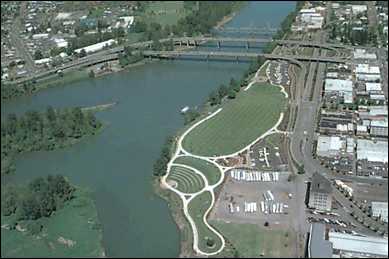
Riverfront Park

Second, contrary to the impression given in Statesman Journal stories, most of the additional testing is being done on RIverfront Park land already owned by the City, and already used by the public. I'd wondered how finding an underground pipe on the railroad right of way adjacent to the 3.8 acre planned purchase could boost the cost of DEQ testing from $150,000 to $350,000.

Testing is required by the Department of Environmental Quality before it will issue the Prospective Purchaser Agreement (PPA) sought by the City of Salem. A PPA limits the liability of someone who purchases previously contaminated land — sort of a "clean bill of health" guarantee.

But a PPA only is granted for land that hasn't already been purchased. So this part of a Statesman Journal story isn't accurate.
Download Salem council to pay for more environmental studies

The council agreed to use $200,000 in urban renewal funds for the environmental work. The environmental studies are needed to protect the city's interests, as it prepares to buy 3.8 acres for an expansion of Riverfront Park, city officials said.

This can't be true, given what John Wales, the City's Urban Development Director, said in an email message to the Councilor Tesler constituent (full message can be found in a continuation to this post).

The proposed new tests along the banks of the Pringle Creek and the Slough will be paid with Urban Renewal funds from the Downtown Riverfront and South Waterfront URAs. Of the 19 proposed test sites, four are located on/or adjacent to the 3.8 acre Park Parcel while the remaining 15 are located on the edge of Riverfront Park.

Thus only four of the 19 tests appear to be needed for the Prospective Purchaser Agreement.

Fifteen are on current Riverfront Park property. Meaning, City officials are concerned that there could be dioxin and other contaminants on the banks of Pringle Creek and the Willamette River Slough that are already accessible to park users.

This raises some questions:

(1) How did City officials become aware that part of Riverfront Park could be contaminated by noxious chemicals? How long have they known this?

(2) Given that Riverfront Park has been converted from a former Boise Cascade industrial site, was adequate environmental testing done before the property became a public park? Why is the shoreline testing only being done now?

(3) Won't the footings for the soon-to-be-built Minto Brown Pedestrian Bridge disturb the ground in the area of the 15 Riverfront Park test sites? Will this increase the cost of the bridge, if contaminants are found?

(4) Why are urban renewal funds being used to pay for the entire $200,000 worth of environmental testing, since only about $42,000 of that amount (4/19 of $200,000) apparently is for test sites related to the Prospective Purchaser Agreement sought as part of the deal to buy 3.8 acres from Mountain West Investment for an addition to Riverfront Park?

Regarding that last question, I'm no expert on urban renewal. But I've always thought it had to do with improving rundown areas and changing their character, not maintaining what already exists in a city.

Most of the $200,000 is being used to test for contaminants in an existing city park, Riverfront Park. Expenditure of that money seemingly has little or nothing to do with the proposed purchase of the 3.8 acre addition to Riverfront Park. It seems to me the 15 test sites should be considered park "maintenance," while the four test sites related to the new potential park acreage is "renewal."

[Update: I just noticed that this agenda item for the Urban Renewal portion of the September 8 City Council meeting claimed that the entire $200,000 is needed to complete the purchase of the 3.8 acres. This seems decidedly misleading. How is testing for contaminants on property the City already owns, which have no way of affecting the 3.8 acres (being downhill and downstream of the 3.8 acres) needed for "environmental due diligence" regarding the proposed purchase?]

(a)  Grant Agreement for Environmental Due Diligence Necessary to Purchase 3.8 Acre Park Parcel – Ward 1 – Board Member Bennett – CANDO (UD)

Recommended Action:  Approve the grant agreement, attached to the staff report, to provide $170,000 of Riverfront-Downtown and $30,000 of South Waterfront Urban Renewal Area funds, a total of $200,000, to the City of Salem for environmental due diligence necessary to acquire 3.8 acres of land adjacent to Riverfront Park.

I look forward to learning how City councilors and other officials answer these questions. If I don't have an accurate or complete understanding about what is going on here, I'm open to being educated.

Comment away on this post, City leaders. (I'll send them a link.)

Here's the complete message from John Wales, and my reply to him.

New City of Salem “corporate welfare” giveaway to Mountain West Investment

Tonight the Salem City Council, in its Urban Renewal Agency guise, is going to decide whether to spend $200,000 to investigate possible pollution on private property that might affect a planned expansion of Riverfront Park. Download New environmental tests loom for Riverfront park land During environmental investigations related to the city's planned purchase of 3.8 acres at the former Boise Cascade site, a long-forgotten pipeline was found. The pipe, a remnant of a paper manufacturing operation's bleach plant, has raised environmental questions. Those questions will need to be answered before the city attempts to expand Riverfront Park. John Wales, the…

Video of zany marching band at 2014 Salem Sunday Streets

I loved today's second annual Salem Sunday Streets. Soon I'll share photos and some commentary on the way-fun event in another post. Here's a preview. That's our dog, ZuZu, in front! For now, enjoy my iPhone video of the astoundingly entertaining MarchFourth Marching Band from Portland, Oregon. The stiltdancers... amazing.  

Salem’s downtown parking debate: a view from Carole Smith

In my last Strange Up Salem column in Salem Weekly about downtown parking, I asked a simple question, "Can we all get along?" Great question, Rodney King. Police brutality isn’t the same as heated debates over how to handle downtown parking, but the unnecessary fighting over this issue also is bothersome. At its last meeting the city council initiated the return of a 3-hour time limit even though discussion of downtown parking was billed as “informational” on the agenda, with no action expected. Yet without advance notice a motion suddenly appeared and was quickly passed unanimously. This violated the spirit,…

“Oregon Marijuana Education Tour” coming to Salem area under cloud of scandal

When I first learned about the so-called Oregon Marijuana Education Tour, it sounded like what I now know it really is: a thinly-disguised political campaign against Measure 91 -- which will legalize recreational marijuana in this state if voters approve the citizen initiative in November.  Today Oregon Represenative Earl Blumenauer called for a federal investigation "to determine if federal taxpayer dollars are being used illegally to influence a statewide election." His letter to federal authorities is here. Links to backup documents are here. This is a big deal. Portland's Russ Belville, a.k.a. Radical Russ, has done some great reporting on…

Save ancient trees and Howard Hall from Salem Hospital’s greed

Let's understand one thing about Salem Hospital: it is the biggest part of a giant corporation, not a small community health care provider. The revenue of Salem Health, its parent organization, was over $500 million a few years ago. It's CEO, Norm Gruber, is said to make over a million dollars a year now. He made $877,000 in 2011.  So this is one reason I'm rooting for an elderly blind woman, Beverly Rushing, who is going up against Salem Hospital in her appeal of the City of Salem's outrageous approval of the hospital's plan to needlessly cut down thirty majestic…