“Shell No” Greenpeace protest in Portland — a brave call to action for all of us
Cheerful conversation in the Camp Sherman store
Salem’s Mayor and City Council scoff at sustainability
Warmest winter in Salem. But are City leaders global warming deniers?
Why legal marijuana may spur changes in Oregon land use laws
Will Oregon’s low carbon fuel bill be horse-traded away?
Salem’s leaders need to say where they stand on climate change
It's time — no, way past time — for community leaders here in Salem, Oregon to answer three questions about climate change/global warming.
(1) Do you believe that global warming is occurring, and is causing the Earth's climate to change in various ways?
(2) Do you believe that humans are mostly responsible for the global warming/climate change that is occurring?
(3) Do you believe that humans need to engage in actions to deal with both the causes of global warming and its detrimental effects on humanity?
These are the questions I asked Salem's Mayor, City Manager, and city councilors about a year ago. (See "I ask Salem-area leaders about climate change.")
Only two city councilors out of the ten City of Salem officials responded to me. They agreed with the scientific consensus, saying "Yes" to each question.
The others wimped out, probably because they fear being held accountable for City Hall's environmentally destructive policies: pushing for a billion dollar sprawl-inducing carbon-spewing unneeded Third Bridge; allowing large, beautiful, healthy trees to be cut down for no good reason; ignoring the urgent need for bike lanes and pedestrian safety while throwing big bucks at 1950's style autocentric road projects.
it isn't only City officials who are in the environmental dark ages. Salem Hospital, the Chamber of Commerce, and other corporate types are acting just as destructively.
This was the theme of my most recent Strange Up Salem column in Salem Weekly, "Salem fiddles while the planet burns." Excerpt:
Officials at City Hall currently are led by a Mayor, City Manager, and city councilors whose general attitude toward caring for our one and only Earth is decidedly at odds with the values of most local citizens and Oregonians as a whole.
Last year I wrote to them, asking if they believed global warming was happening, humans are mostly responsible, and we need to do something about it.
Only two out of the ten top City of Salem officials said “yes.”
The rest cowered in a science-denying hidey-hole, unwilling to admit that their support for environmentally destructive actions was at odds with the obvious necessity to do everything possible to avert catastrophic changes to the ability of our planet to support human civilization.
So while both the Earth and the western United States experienced record warmth in 2014; while ski resorts in Oregon face steadily declining snowpacks as hotter air causes more precipitation to fall as rain; while drought becomes an ever-increasing threat to farmland and forests…
Salem’s clueless politicians and corporate executives go on their merry Screw the Planet way.
I'm hoping that our local chapter of 350.org will take this on as a project — pressing local leaders to make clear how they regard the most important issue of our time, keeping the Earth a friendly place for civilization to prosper.
Since global warming obviously is a planet-wide problem, there's no place to hide from the consequences of human-caused climate change.
LIkewise, government, corporate, and non-profit leaders at every level, including local, can't be allowed to hide when asked whether they believe in the scientific consensus underlying my three questions.
If they don't accept that consensus, so be it. If they agree with the consensus but aren't willing to act in accord with it, so be it. Best of all, of course, is for them to both agree with the reality of human-caused global warming and accept the need to vigorously act to reduce its already-disastrous effects.
I'll share my entire Salem fiddles while the planet burns column as a continuation to this post.
Hunters have mistaken view of wildlife “management” in Oregon
On the need for wild places, and the wisdom to preserve them
Global warming is real, David Titley tells Salem City Club
Republican denial of global warming makes me hate the GOP
Why a photo of a dead deer makes me feel hunting is wrong
How contaminated is Salem’s Riverfront Park? More info on DEQ testing.
The story keeps getting more interesting of how the Salem City Council is spending $200,000 to conduct additional tests for dioxin and other nasty chemicals in and around heavily used Riverfront Park.
Yesterday I blogged about a "New City of Salem 'corporate welfare' giveaway to Mountain West Investment." It bothered me that public urban renewal funds were being used to test for contaminants on private land that is now, and will remain, owned by Mountain West Investment.
I could understand why the City wanted to test for pollution from the old Boise Cascade operations on the 3.8 acres west of the railroad tracks. Mountain West has agreed to sell this part of its property to the City so it could be added on to Riverfront Park.
But, I wrote:
There's more to this issue, though. Now I've got even more questions about how City officials are handling this issue.
First, the City Council, Mayor, and City Manager discussed the additional $200,000 worth of environmental testing in a closed executive session. A consituent of Councilor Laura Tesler asked her to explain why taxpayers were paying for testing on Mountain West Investment property.
Tesler replied that since this was discussed in an executive session, she couldn't say anything about the meeting. So Tesler told the constituent that she'd try to get information from City staff.
Now, I don't think it is a wild, crazy, Green-freak, eco-zealot notion to expect that discussions about possible dioxin and other contamination adjacent to or in a public park should be completely open to the citizenry.
The only reason I can think of why this was discussed in a closed executive session is that confidential matters relating to Mountain West Investment business plans and financing were talked about.
If so, this fits into my "corporate welfare" conspiracy theory. If not, what other reason would there be to shut out the public and press?
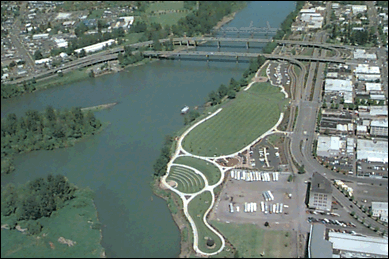
Second, contrary to the impression given in Statesman Journal stories, most of the additional testing is being done on RIverfront Park land already owned by the City, and already used by the public. I'd wondered how finding an underground pipe on the railroad right of way adjacent to the 3.8 acre planned purchase could boost the cost of DEQ testing from $150,000 to $350,000.
Testing is required by the Department of Environmental Quality before it will issue the Prospective Purchaser Agreement (PPA) sought by the City of Salem. A PPA limits the liability of someone who purchases previously contaminated land — sort of a "clean bill of health" guarantee.
But a PPA only is granted for land that hasn't already been purchased. So this part of a Statesman Journal story isn't accurate.
Download Salem council to pay for more environmental studies
The council agreed to use $200,000 in urban renewal funds for the environmental work. The environmental studies are needed to protect the city's interests, as it prepares to buy 3.8 acres for an expansion of Riverfront Park, city officials said.
This can't be true, given what John Wales, the City's Urban Development Director, said in an email message to the Councilor Tesler constituent (full message can be found in a continuation to this post).
The proposed new tests along the banks of the Pringle Creek and the Slough will be paid with Urban Renewal funds from the Downtown Riverfront and South Waterfront URAs. Of the 19 proposed test sites, four are located on/or adjacent to the 3.8 acre Park Parcel while the remaining 15 are located on the edge of Riverfront Park.
Thus only four of the 19 tests appear to be needed for the Prospective Purchaser Agreement.
Fifteen are on current Riverfront Park property. Meaning, City officials are concerned that there could be dioxin and other contaminants on the banks of Pringle Creek and the Willamette River Slough that are already accessible to park users.
This raises some questions:
(1) How did City officials become aware that part of Riverfront Park could be contaminated by noxious chemicals? How long have they known this?
(2) Given that Riverfront Park has been converted from a former Boise Cascade industrial site, was adequate environmental testing done before the property became a public park? Why is the shoreline testing only being done now?
(3) Won't the footings for the soon-to-be-built Minto Brown Pedestrian Bridge disturb the ground in the area of the 15 Riverfront Park test sites? Will this increase the cost of the bridge, if contaminants are found?
(4) Why are urban renewal funds being used to pay for the entire $200,000 worth of environmental testing, since only about $42,000 of that amount (4/19 of $200,000) apparently is for test sites related to the Prospective Purchaser Agreement sought as part of the deal to buy 3.8 acres from Mountain West Investment for an addition to Riverfront Park?
Regarding that last question, I'm no expert on urban renewal. But I've always thought it had to do with improving rundown areas and changing their character, not maintaining what already exists in a city.
Most of the $200,000 is being used to test for contaminants in an existing city park, Riverfront Park. Expenditure of that money seemingly has little or nothing to do with the proposed purchase of the 3.8 acre addition to Riverfront Park. It seems to me the 15 test sites should be considered park "maintenance," while the four test sites related to the new potential park acreage is "renewal."
[Update: I just noticed that this agenda item for the Urban Renewal portion of the September 8 City Council meeting claimed that the entire $200,000 is needed to complete the purchase of the 3.8 acres. This seems decidedly misleading. How is testing for contaminants on property the City already owns, which have no way of affecting the 3.8 acres (being downhill and downstream of the 3.8 acres) needed for "environmental due diligence" regarding the proposed purchase?]
Recommended Action: Approve the grant agreement, attached to the staff report, to provide $170,000 of Riverfront-Downtown and $30,000 of South Waterfront Urban Renewal Area funds, a total of $200,000, to the City of Salem for environmental due diligence necessary to acquire 3.8 acres of land adjacent to Riverfront Park.
I look forward to learning how City councilors and other officials answer these questions. If I don't have an accurate or complete understanding about what is going on here, I'm open to being educated.
Comment away on this post, City leaders. (I'll send them a link.)
Here's the complete message from John Wales, and my reply to him.

Climate change is the big job-killer, not EPA carbon regulations
Outrage: the true story of Salem’s U.S. Bank tree killings
Salemians, come see “Wild Things” April 3, Loucks Auditorium
I ask Salem-area leaders about climate change
Time for public officials to “come out”… about climate change
Cougar bill killed, thankfully, in 2013 Oregon legislature
My wife and I agree with Democratic state Represenative Brian Clem on most issues. But not on allowing individual counties to overturn Oregon's statewide ban on using dogs to hunt cougars.
This legislative session Clem sponsored House Bill 2624. The bill would have permitted county-by-county votes on a question that a majority of Oregonian voters said "NO" to twice: whether dogs should be allowed in cougar hunting.
Thankfully, HB 2624 never made it out of committee in the state Senate.
How to manage mountain lions became one of the more hotly debated issues of the session. Clem led the charge to allow counties to opt out — by a local vote — of the law that bans the use of hounds to hunt the lions. He won big in the House, only to see the bill die in the Senate, stymied by Sen. Jackie Dingfelder, a Portland Democrat who chairs the main environmental committee.
There are two main reasons why HB 2624 was a really bad idea. I talked about both of them in written testimony that I submitted to the Senate Committee on Environment and Natural Resources (attached in full as a continuation to this post).
First, allowing counties to opt out of voter-approved statewide initiatives would set a horrible precedent. I told the committee:
No longer would statewide initiatives truly apply in the entire state. The legislature will have given a green light to those who fail to defeat an initiative to say, “Hey, you let individual counties opt out of the cougar initiative; now we want the ability to have counties opt out of [whatever].”
Consider Measure 49, a reform of Measure 37, which passed in 2007 with over 60% of Oregonians voting in favor. Yet majorities in many counties were in favor of a weakened land use system. Imagine the legal chaos if a county could opt out of Measure 49. Or any statewide law that a majority of voters in that county deemed unacceptable to them.
Yes, the legislature would have to authorize the ability to opt out of a law. But if you do this in HB 2624, the gate will be opened for other attempts to undo the statewide will of Oregonians — leading to a balkanization of our state. We already are unduly divided by unnecessary political rancor. Do we really want to add to that?
Second, cougars, a.k.a. mountain lions, are not a real problem in Oregon. They are an extremely minor threat to people (hugely less than domestic dogs are), and don't do much damage to livestock. So why kill them?
Well, my wife sat through several HB 2624 hearings. Apparently deer hunters are irked that cougars are killing deer — which, of course, is what cougars do. And why cougars, wolves, and other top predators are part of a healthy ecosystem.
Hunters kill the largest and healthiest game animals. Top predators tend to kill the smallest and weakest. Thus cougars do a better job at game management than hunters do. No reason to hunt them with dogs, as I said in my testimony.
No one has ever been killed by a cougar in Oregon. Many people have been killed by hunters. So if we're really concerned about protecting human life, there should be a thinning of the ranks of hunters, not of cougars.
Irrational hysteria is the only reason this bill has been introduced. My wife and I live around cougars. I've walked by fresh cougar deer kills. I frequently take walks at night in woods frequented by cougars. I'm not afraid of cougars.
Hopefully legislators will become similarly educated about these valuable top predators before they vote on HB 2624. Just as wolf management shouldn't be based on "big bad wolf" fairy tales, neither should cougar management.
Below is the rest of what I said in my testimony. I sure hope I never have to submit something similar again. Let this issue die, Representative Clem.