

Today I got some good news. After seeing an ad in the Oregonian by Energy Trust of Oregon, I took them up on an offer to have reputable solar companies contact me, rather than taking a chance on the many posts I see on Facebook by firms making grandiose claims about how much a homeowner can save by installing their solar panels.
Soon after I filled out an Energy Trust form with my address and contact information, I heard from someone who grew up in our rural south Salem neighborhood, and still lives nearby. Miles Henderson works in sales with Pure Energy Group, a local solar company. His father, Matthew Henderson, is one of the owners of Pure Energy Group, and a neighbor of ours.
When I responded to Miles’ email, I told him that quite a few years ago we were told by several solar companies that the only way we could use solar panels was to cut down some tall fir trees that are close to our house. So I said that if nothing else, at least I’ll feel like I’ve tried my best to get some of our electricity from the sun, as I wanted to see if advances if solar technology made our house more amenable to solar panels.
Turns out, that was the case.
Based on my previous experience, I expected that Miles would get out a ladder, climb up on our roof, and take a look from up there, with an eye toward how much sunshine our house got. Nope, Miles got out his laptop, propped it on the hood of his car, and asked for our wifi password. He then performed some solar assessment magic that I could follow in general, though the details escaped me.
Basically (hopefully I’m right about this), Miles consulted several sources of aerial photographs of our house at various times of the year. I was familiar with Google Maps images, but he also had other ways of looking straight down at our rural house. He said that the heights of trees could be estimated from the shadows they cast.
Large trees near our house became circles on the view-from-above photo he was using. Average sunlight data over the course of a year for our location was thrown into the mix. The most likely spot on our roof for solar panels was selected. Then a calculation showed that we were over the 80% (I think it was percent) standard for qualifying for a $2,500 Energy Trust of Oregon solar panel rebate.
Here’s the proposal that Miles sent to me. The blue rectangle on our roof shows where the 18 solar panels would go. This is a different parr of the roof than where other solar companies wanted to put panels many years ago. The shadow above the panels near the peak of the roof is our wood stove chimney, which would be several feet away from the panels.
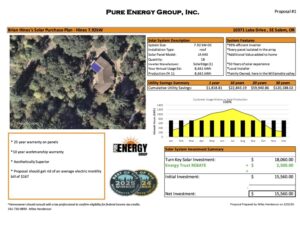
The total cost for a 7.92 kw solar panel installation would be $18,060, or $15,560 after the Energy Trust rebate. With the estimated annual electricity savings of $1,819, this is an 11.7% yearly return on our investment of $15,560. Pretty damn good.
Of course, we’ll have to wait and see how close the estimated electricity savings are to what actually happens. We pay the same amount to PGE every month, as we’re on their equal pay plan. So if our usage doesn’t change much, when PGE adjusts our payment after the solar panels have been up for a year, that should be a good indication of how much we’re saving — along with a direct measurement of how much electricity the panels are generating, which I assume we’ll get.
I’ve become a big fan of Claude, Anthropic’s AI model. I just asked it, “We have a quote to install 18 JA 440 panels for $18,060. Is this a good price?” JA stands for JA Solar, the manufacturer of our solar panels. Claude gave a reassuring response. Claude thinks we live in the Portland area, probably because we use the Starlink satellite system for our broadband connection. The links are the sources of information cited by Claude.
Here’s a full breakdown of how your quote stacks up:
The math on your quote
- 18 panels × 440W = 7.92 kW system
- $18,060 ÷ 7,920W = $2.28 per watt
That’s an excellent price. The national average is about $2.58 per watt before incentives Solar Electric Supply, and the average solar panel cost in Oregon specifically is $2.74 per watt Paradise Solar Energy. At $2.28/W, you’re coming in well below both benchmarks.
Incentives available to you in Portland
This is where things get more nuanced in 2026. Some important context:
- Federal tax credit (30%): The 30% federal tax credit under Section 25D is unavailable for any residential solar project not fully installed and completed by December 31, 2025. SolarReviews So unfortunately that’s gone for you.
- Energy Trust of Oregon (ETO): The standard Energy Trust of Oregon solar incentive for 2026 starts at a flat $2,500 per system for customers of both Portland General Electric and Pacific Power. Solar.com This is applied as an upfront discount — you don’t have to wait for a rebate check.
- Solar Within Reach: If your household income is under roughly $120,000 (for a family of 4), you may qualify for significantly higher rebates of up to $5,400–$6,000 extra. EnergySage
- Property tax exemption: Oregon offers a property tax exemption for residential solar installations — your panels won’t increase your property taxes even though they add value to your home, and this exemption is automatic. EcoFlow
- Net metering: Net Energy Metering allows you to bank credits for excess solar production sent to the grid, which can offset your bill during low-production winter months. Solar.com This is crucial in Portland for making the math work year-round.
Bottom line
Your quote is genuinely competitive — below both the state and national averages per watt. After the $2,500 ETO rebate, your effective cost would drop to around $15,560, and potentially lower if you qualify for the Solar Within Reach income-based program.
Two things I’d confirm before signing:
-
Is the installer an Energy Trust of Oregon Trade Ally? They need to be in order for you to get the ETO rebate applied as an upfront discount.
-
What inverter system is included? The panel price is good, but the inverter choice (string vs. microinverters) affects both performance and long-term reliability and should be spelled out in the quote.
The inverter included in our proposal is from Solar Edge. Google AI had some encouraging words about the inverter.
SolarEdge inverters are high-efficiency, DC-optimized systems that maximize solar production, specifically for shaded roofs, by using per-panel power optimizers. They offer, on average, 97–99% efficiency, 12–25 year warranties, and built-in safety features like rapid shutdown, usually costing between $1,500 and $2,600+ for residential units.
Here’s the business card Miles Henderson gave me. I was impressed with Miles. Competent, pleasant, low key. Contact him if you’re interested in a solar installation somewhere in Oregon. Mention my name, Brian Hines, as Pure Energy Group has a $500 referral bonus that would lower the cost of our solar panels even more.
Discover more from Hinessight
Subscribe to get the latest posts sent to your email.