

I had a breakthrough in my soccer watching today.
My habitual joke — which isn’t really a joke because it’s been true — is that the only way I can watch soccer is record the match, then fast forward at triple or quadruple speed until I see the score has changed, then go back a minute or two to see how the goal was scored.
Something changed today.
I started watching my recording of the England vs. Norway World Cup quarterfinal match and didn’t feel an urge to fast forward. Yes, I did press the 30 second advance button a bunch of times, perhaps as a way to ease my transition into what happened in the second half: watching the match without skipping much aside from hydration breaks and lengthy injury pauses in the action.
Finally I could appreciate the beauty of the sport. The lack of scoring became a feature, not a bug. I could better understand why fans get so excited when their team scores a goal, or even comes close to scoring. Because it’s so damn rare, and a goal is so damn difficult.
Baseball, basketball, football — hands and feet are used to play the game. But soccer takes away our marvelous human hands for most players (goalie excepted) most of the time (hands are only okay with throw ins and positioning of the ball after a penalty, basically).
So the skill of handless players having to use only their head, chest, legs, and feet to do soccer stuff became a wonder to behold. Maybe it took the World Cup for me to appreciate this, as these are the cream of the crop of each nation’s professional soccer stars.
Though I mostly had to rely on the commentary of the World Cup announcers on Fox to grasp the strategy of each team, I was better able to absorb this myself, partly from how I felt watching the match.
For much of the first half, England vs. Norway was like watching paint dry. Pretty boring. Apparently the cautious play of each team had a lot to do with the high temperature and humidity, as the players were saving energy by walking rather than running and passing in slow motion. However, I did read a story in the New York Times today about how Lionel Messi, the Argentina super star, has been walking 63% of the time in the World Cup.
The best players make soccer look like a walk in the park. For Lionel Messi, it often is.
Argentina’s 3-2 comeback victory against Egypt in the round of 16 took an emotional toll, with Messi uncharacteristically bursting into tears after the final whistle. Physically, though, he hardly broke a sweat.
As in every game he has played at this tournament, Messi spent most of it walking. Walking has accounted for 63 per cent of his movement across the World Cup, a share that is far clear of any other outfield player in the competition.
And even these strolls were among his more energetic movements, with Messi spending a further 25 per cent of the match simply standing still. Occasionally, 8.6 per cent of the time to be precise, he breaks into a jog, lagging far behind the tournament average of 23 per cent, while he rarely accelerates into a sprint.
Marvelous. This made me even more of a soccer fan. You can be a huge success as a player by taking it easy. (Well, if you have amazing talent and your teammates are running around much more energetically.
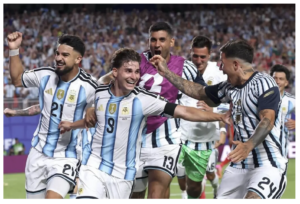
Argentina vs. Switzerland was equally entertaining. I watched this second match with even less fast-forwarding. It went to overtime, and featured a mystifying video replay controversy that I can barely understand even after reading about what happened several times. But that’s part of the appeal of soccer, from what I’ve heard. Consequential referee decisions are debated endlessly almost as much as momentous goal scoring.
For those wanting a crash course in soccer video review rules, here’s an excerpt from the NYT story linked to above.
In the 72nd minute, Switzerland were in the ascendency against the world champions. They had equalised five minutes prior through Dan Ndoye and an exit appeared eminently possible for Argentina. Then came one of the most extraordinary moments of the tournament.
At first glance, it appeared that Leandro Paredes had cleaned out Breel Embolo and the Portuguese referee Joao Pinheiro pulled out a yellow card for the Argentinian.
Then, the VAR team in Dallas intervened. They looked at multiple replays, which appeared to show there had not been any contact and Embolo had thrown himself to the ground.
Given the location, far from goal and near the touchline, there did not appear to be an obvious advantage to be gained. It may have been that, with Paredes approaching at speed, Embolo anticipated contact that didn’t come and fell over. Regardless, it is hard to argue Embolo did not dive.
The VAR [Video Assistant Referee] recommended that Pinheiro review the incident. As the images played out, it emerged they were studying the replays for “mistaken identity” — i.e. that the wrong player had received a yellow card.
Ordinarily, fans would presume mistaken identity would apply if the yellow card had been incorrectly shown to a player other than Paredes. But FIFA appears to be taking a liberal interpretation of this phrase.
On review, the official withdrew the booking for Paredes and showed one instead to Embolo. Given he had been booked in the first half (for fouling Paredes, ironically), that meant a red.
Guidance from FIFA does not limit match officials to interpreting the ‘mistaken identity’ rule to players of the same team. The rules says that “if the referee penalises an offence but has clearly misidentified the player who committed that offence, only the identity of the attacker can be reviewed”.
Under rules brought in for the World Cup, the reviewable decisions and incidents now include mistaken identity when the referee shows a yellow or red card but clearly penalises the wrong player of either team. As such, Pinheiro was correct in reversing his original decision, leaving Embolo in tears and in need of consoling by team-mates.
The irony here is that if the referee had not shown a yellow card to Paredes, the incident could not have been reviewed on the merits of Embolo’s dive alone. It required a card to be shown to Paredes in order to trigger the protocol.
Clear as mud, right? At least the NYT reporter seems to understand the rules at play here.
I’m still largely baffled by what went on. Just seemed really strange that cancelling a yellow card against an Argentina player ended up with a second yellow card being assessed against the Switzerland player involved in the incident, causing him to be thrown out of the match, leaving Switzerland playing with only ten men from that point on, because he dove to the ground, possibly not on purpose but because he fell over.
Yeah, soccer can be really strange. Which is a reason I’ve become a fan!
Discover more from Hinessight
Subscribe to get the latest posts sent to your email.