

Many years ago, a female massage therapist said, while we were chatting during the session, “I make more mistakes than my sister because I try more new things.”
I’ve never forgotten that line. It often comes to mind when I make a mistake, which is frequently. Mistakes bother me, especially when I should know better and simply screw up because of a lack of concentration, my mind having drifted off to another time and place instead of focusing on the task at hand.
Yet if I make a mistake while trying something new, I do my best to look kindly upon myself. After all, mistakes are to be expected when we’re exploring new territory. If we were sure where we’d end up, it wouldn’t be an exploration, but a trip down a well-trodden path.
In the February 7, 20226 issue of New Scientist, I came across a letter to the editor that was titled “Why you should treat life like a science experiment.” It was from Simon Ward, Lutterworth, Liecestershire, UK. He said:
Congratulations to Grace Wade for succeeding in her New Year’s resolution to run a half-marathon last year.
I’m a little skeptical about some of the claims derived from countless PR-fodder surveys about New Year’s resolutions, but it does seem to ring true that our tradition of setting big, long-term goals at the start of January isn’t always that effective.
Perhaps it is just a case of different approaches working for different people? For what it’s worth, my current favourite approach is the Tiny Experiments method developed by neuroscientist Anne-Laure Le Cunff: ditch linear goals, and treat life more like a science experiment.
Develop a hypothesis, put it to the test, evaluate the results, adapt, and go again. Essentially, embrace trial and error, and don’t feel bad about the failures — it’s all valuable data!
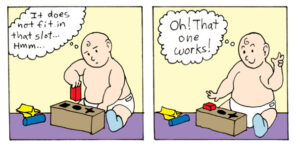
For sure. After all, embracing trial and error was how we started off in life as an infant. It worked then. It will still work now. The main difference being that as infants, we weren’t self-conscious about making mistakes. We tried, failed, then tried again. As an adult, we’re more prone to disliking failure, so we may become reluctant to try new and different things.
A couple of years ago I started having trouble digesting food that I used to eat regularly with no problem. Like lentils. And apples. And soy milk. I learned about the FODMAP diet approach to dealing with irritable bowel syndrome and similar afflictions. This provided me with a sense of control over my digestion problem, but over time I found myself eating a boring, limited diet.
Eventually I got tired of being afraid to eat so many things that I liked. So in a fuck this! moment I decided to start eating some of my favorite foods, just to see what would happen. Which was a Tiny Experiment, even though I didn’t call it that. It turned out that when I found I could get back to eating a food that I’d been missing, I felt better, which made me more confident about experimenting with another food that I’d discarded from my diet.
Sure, there were some setbacks along the way. However, simply moving to a trial-and-error frame of mind, rather than feeling I had to rigidly control what I ate, made a lot of difference.
Checking out the Tiny Experiments method of Le Cunff just now, I found a transcript of a TEDx talk she gave called How Tiny Experiments Can Set You Free. Here’s how it starts out. I like what she says about control.
“One second. I need to check my calendar.” That’s what I said to the doctor while he was telling me that I might die. I was 26, sitting in a wheelchair, diagnosed with a blood clot that could travel to my lungs. They just told me I needed emergency surgery. And how did I respond? By trying to negotiate my to-do list. I know how absurd this sounds, but it does make sense when you think about it.
In that moment, despite the seriousness of the diagnosis, or perhaps because of it, I wanted to feel in control. I wanted to believe that I could stay in charge of what happened next. And so when I heard the news, instead of shifting my footing, I held on tighter to the calendar, to the identity of being the one who never falls behind.
I’m sure you’ve had your own version of that moment when something cracked open in your life and your first instinct was to ask, “How do I stay in control?” In those moments, we tell ourselves, “I’m the productive one. I’m the calm, the quiet, the supportive one, the one who never drops the ball, the one who always has it together, the one who keeps everyone happy.” We all carry these deep assumptions about who we are. And when life feels uncertain, we tighten our grip, not just on the situation, but on the identity we’ve built.
So, here’s the question I’d like to explore with you. What if the thing keeping you stuck isn’t your circumstances, but your grip on who you think you need to be? Let me explain how that works. Our minds crave a sense of order. So, when real control disappears, the brain will manufacture an artificial sense of control however it can. That’s why when things feel uncertain, we reach for anything, absolutely anything that helps us feel steadier. How many of us have added another app, another routine, another system when life felt chaotic? We all do this to the point where this behavior has a name.
Psychologists call it compensatory control, which is our attempt at restoring order by creating structure, even if it’s artificial. And we’re not just wired that way. We’re trained this way. Our schools and our societies reward us for being prepared, for being certain, for being right. And so when things feel wobbly, we try to escape that liminal space as quickly as possible rather than pausing to explore.
And now here’s the tricky part. In the short term, it feels like it works. Predictable structures help lower the perceived threat and downregulate the stress response. Planning feels responsible and productive, so you feel a bit calmer, and yes, in control. But over time, this artificial sense of control narrows your options.
You can’t receive what life is actually offering when you’re too busy managing what you think it should be offering. And when you’re trying to control everything, you leave no room for discovering anything, including about yourself. And that’s the real trap. Control doesn’t just keep us stuck in our circumstances, it keeps us stuck in our current identity.
So if control isn’t the answer, what is? That’s what I started wondering after this absurd moment at the hospital. And I know, I know that in that kind of talk, you’re supposed to say that you had a big breakthrough. But in my case, the shift came from something a bit smaller. It came from a little bit of experimentation.
See, as a neuroscientist, I’ve been trained to conduct experiments in the lab. But I’ve come to realize that experimentation is much more than just a scientific method. It’s everywhere. It’s how nature evolves. It’s how species adapt. It’s how we learn to walk and talk as children. Experimentation is the fundamental way life moves forwards.
And there’s something in particular that’s very interesting about experimentation, something that can help us move forward while loosening our grip. The thing is, we don’t run experiments to get to a specific outcome. If we already knew the outcome, there would be no point running the experiment in the first place. We experiment to learn something new, whether that’s a new data point, a clearer picture of reality. Instead of asking how can I stay in control, we ask what can I try?
Discover more from Hinessight
Subscribe to get the latest posts sent to your email.