

Today the judge in the Lindsay Clancy murder case declared a mistrial, because the 12-person jury couldn’t unanimously agree on a verdict. Eleven jurors thought that Clancy was innocent of the first degree murder charge — which seemed to be an absurd charge, given that she suffered from postpartum psychosis when she killed her three children.
One member of the jury reportedly told the foreman that he had doubts about Clancy’s guilt. That should have led him to vote with the other eleven jurors, since they were required to find beyond a reasonable doubt that Clancy was guilty of first degree (premeditated) murder. But since he told the judge that he was capable to following the jury instructions, he was left on the jury, which couldn’t reach a unanimous decision.
I didn’t follow the Clancy trial very closely until the final days. Lindsay Clancy’s situation is a tragedy. The focus has been on whether Clancy truly was under the influence of postpartum psychosis at the time she murdered her children. Sure seems so, given what a sympathetic opinion piece in today’s New York Times says.
When she jumped out a second-story window of her suburban Massachusetts home, Lindsay Clancy did not put her hands out to break her fall.
This detail from the weekslong trial of Clancy, a former labor and delivery nurse who was charged with murdering her three small children, is one I cannot shake. Both the defense and the prosecution agree that Clancy suffered from mental illness in the period leading up to the killings and her suicide attempt. “She really did a free-fall dive headfirst” onto the “hard, frozen ground,” said Dr. Elizabeth Laposata, a forensic pathologist and a former chief medical examiner in Rhode Island, who testified for the defense on Aug. 18.
Clancy, who pleaded not guilty, pitched herself from the window after cutting her wrists and taking pills. She is now paralyzed from the waist down. She has said she heard a voice telling her to kill the kids and herself before she strangled them. The defense argued that she is not criminally responsible for this unconscionable tragedy because she was suffering from postpartum psychosis.
The prosecution’s argument was that even though she was certainly depressed and suffering, the killings were premeditated. It argued that her suicide attempt was not serious — her wounds were superficial, and she described taking the pills in a vague fashion — that it was a cynical, premeditated calculation.
My view is that Clancy shouldn’t have been criminally charged in the first place, so the prosecution definitely shouldn’t try to convince a second jury to convict her. But I go a lot farther than the persuasive defense argument that Clancy was not guilty by reason of insanity (or whatever the technical legal jargon is). Because I don’t believe anybody has free will, regardless of their mental condition.
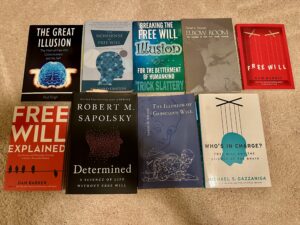
Though most people disagree with me, this isn’t at all a fringe position. Here’s nine books that I’ve read about the lack of free will. They all contain solid arguments against free will, especially Robert Sapolsky’s Determined, which is full of scientific evidence in favor of his thesis that free will is an illusion. Einstein didn’t believe in free will, saying:
I do not believe we can have any freedom at all in the philosophical sense, for we act not only under external compulsion but also by inner necessity. Schopenhauer’s saying—’A man can surely do what he wills to do, but he cannot determine what he wills’—impressed itself upon me in youth and has always consoled me when I have witnessed or suffered life’s hardships.
I’ve written 100 posts about the illusion of free will on my Church of the Churchless blog. Several focus on how our legal system assumes that free will is real, despite all the evidence that it isn’t. In 2018 I wrote, “A justice system not based on a belief in free will would be much better.” I included a quotation from a British attorney, Richard Oerton, author of The Nonsense of Free Will, that describes a more rational, fair, and compassionate legal system.
In a system which made no concessions at all to irrationality, retributive punishment would play no part whatsoever, but the other aims of sentencing set out at the start of Chapter 21, would still be relevant.
[These are: (b) the reduction of crime (including its reduction by deterrence); (c) the reform and rehabilitation of offenders; (d) the protection of the public, and (e) the making of reparation by offenders to persons affected by their offences.]
The overriding purpose would simply be the protection of society through the prevention of crime. The focus would be on the harmfulness, rather than the wickedness, of the offender. Imprisonment would still be necessary in very many cases — and in the case of offenders who were both dangerous and unreachable, it might have to last a very long time — but subject to that, the aim of those involved in the penal system would be to decide on the approach best calculated to turn the offender away from crime.
It is here, in relation to the treatment of offenders, and not in the hair-splitting statutory rules about deserts and culpability, that their varying mental states would be important. Under our present system, reform of the offender hardly gets a look-in, and our prisons are full of people with mental illness which goes largely untreated.
Official statistics tell us that three-quarters of prisoners have below average I.Q.s, that over two-thirds have one or more mental health disorders and that nearly one-tenth are psychotic (that’s to say, insane).
The only prison in the country which is run entirely on therapeutic principles is Grendon. Its regime, far from being soft or lenient, makes much greater demands on the prisoners than any ordinary prison: a consultant psychiatrist uses unexpectedly colourful language in saying that it provides “group therapy with turbo-charged-rocket-boost-high-voltage-plasma-engines, going at warp factor ten.”
I also included a comic strip that demolishes the argument for free will in a humorous fashion.

Lindsay Clancy killed her children because of causes she had no control over. If everything in the universe was just the same as when she committed the murders, Clancy would do the same thing: kill her children. Likewise, at this moment you, and I, and every other human is doing whatever we’re doing because of causes we have no control over.
If you don’t believe this, read my 2025 blog post, “A British attorney denies free will in saying no to, ‘Could he have done otherwise?'”
And if you want to use a disbelief in free will to get out of jury duty, check out my 2012 post, “Sitting in the jury box, I deny free will.” Excerpt:
It was the male prospective juror sitting in front of me who opened up my opportunity. The defense attorney said that the defendant had some sort of mental illness. He asked the twelve of us if this affected how we looked upon his client.
The man raised his hand. The defense attorney called on him. The guy said he didn’t believe that mental illness absolved someone of responsibility for a crime. More: he said that even a meth addict was responsible for what they did while high.
That hit my neuroscience button. I felt like I had to say something in response. I raised my own hand. After the attorney recognized me, I spoke along these lines:
“Here’s a yang perspective to the yin view expressed by the man in front of me. He believes in personal responsibility. I say, free will is an illusion. I’m an avid reader of neuroscience books. It’s almost universally agreed by the authors that free will doesn’t exist.
Mentally ill people don’t have free will. Neither do mentally healthy people. We’re all just doing stuff for reasons other than free will. Yet the justice system is based on free will. Retribution is ridiculous given the illusion of free will.
There can be other reasons for a sentence than retribution, of course. But punishing someone for a freely willed action isn’t a valid reason, since there is no such thing as free will.”
As so often happens, when I stopped speaking I thought, Wow, I make so much sense to me. In my usual grandiose way, I halfway expected the judge and attorneys to applaud. Then, vow that they were quitting the legal profession until legal codes were brought up to date with modern neuroscience.
However…
What actually happened is that the defense attorney said “Interesting…” I then had another familiar thought: My profound pronouncement about the nature of reality is not being embraced by those less enlightened than me.
Which didn’t really bother me, since the uncomprehending “thud” with which my dissertation about free will hit the courtroom gave me hope that I’d now be looked upon by one or both of the attorneys as a weird unpredictable intellectual philosophical crank outlier.
In short, poor juror material.
Indeed, after a ten minute break following the voir dire period, I was super happy to see other people called up to fill the first six chairs in the jury box. The rest of us were dismissed. Joy!
I can’t be sure that my free will comments helped me get out of jury duty. But I suspect they did.
Discover more from Hinessight
Subscribe to get the latest posts sent to your email.